© 2026 NervNow™. All rights reserved.

 ByNN Desk
India AI Summit Concludes: 88 Nations Sign the New Delhi Declaration
The India AI Impact Summit 2026 concluded with 88 nations, including the US, China, and Russia, endorsing the New Delhi Declaration on AI.
The India AI Impact Summit 2026 concluded with 88 nations including the US, China, and Russia endorsing the New Delhi Declaration on AI.
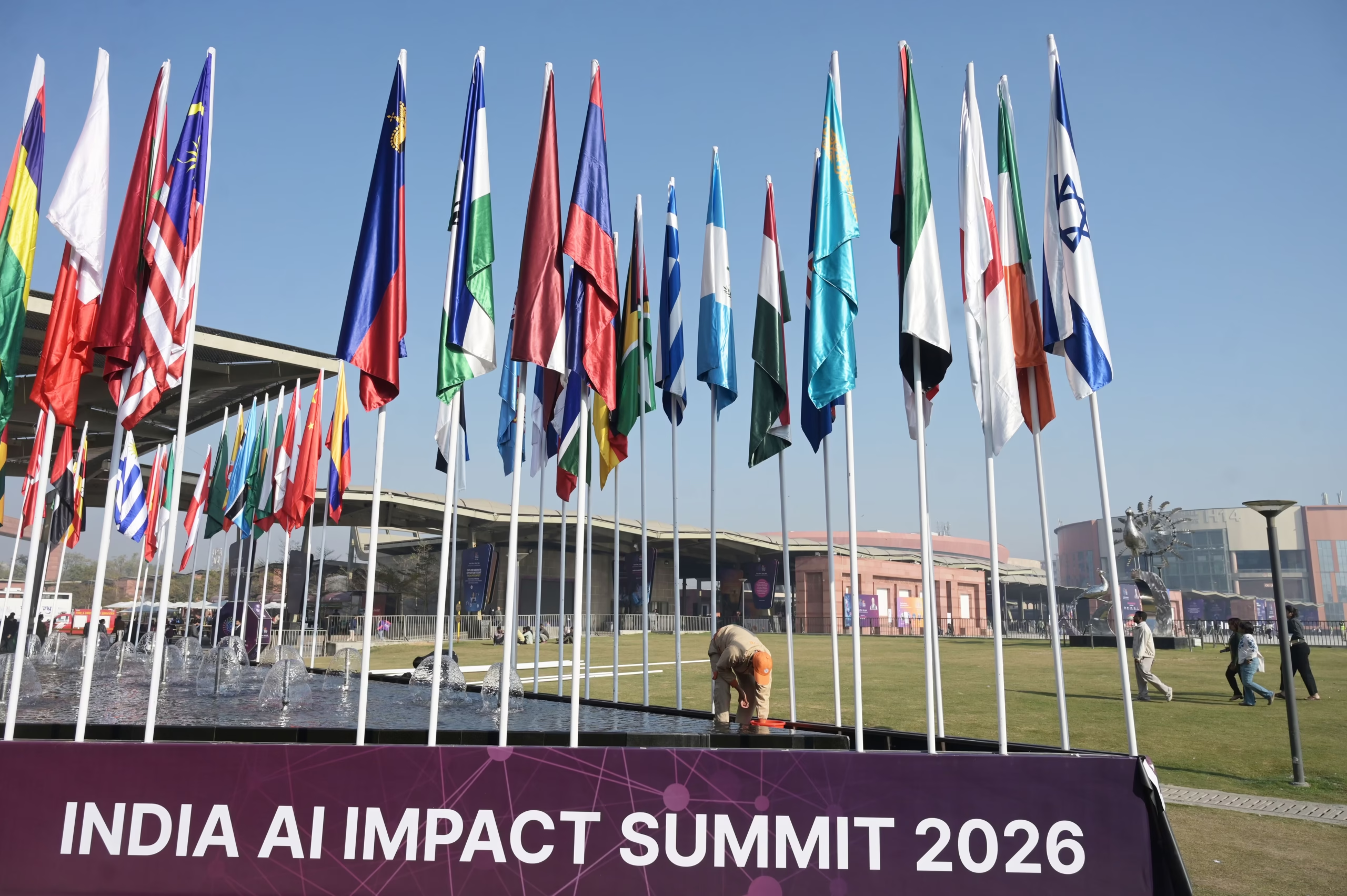
India’s most ambitious diplomatic moment in technology just became official. The India AI Impact Summit 2026 held at Bharat Mandapam in New Delhi from February 16 to 20, concluded on February 21 with the formal adoption of the New Delhi Declaration on AI Impact, endorsed by 88 countries and international organisations.
The declaration marks the broadest international consensus on AI governance ever assembled in the Global South, and represents a decisive shift in the geography of AI policymaking, away from the traditional Washington-Brussels-Beijing triangle and toward a multipolar framework in which India is a central voice.
The New Delhi Declaration is a voluntary, non-binding agreement that calls on all participating nations to pursue AI development in a manner that is inclusive, human-centric, trustworthy, and equitable. It is guided by the Sanskrit principle of Sarvajan Hitaya, Sarvajan Sukhaya welfare for all, happiness for all which PM Modi introduced as the philosophical backbone of India’s approach to AI governance.
The document is structured around seven strategic pillars: democratising AI resources; advancing economic growth and social good; building secure and trusted AI; promoting AI for science; expanding access for social empowerment; strengthening human capital; and developing resilient, efficient and innovative AI systems.
Also read: Altman vs Amodei: AI Rivals Refuse to Hold Hands at Modi Summit
Critically, the declaration also calls for meaningful, affordable connectivity as a prerequisite for deploying AI an acknowledgment that much of the Global South remains excluded from AI’s benefits due to infrastructure gaps. It takes note of the Charter for the Democratic Diffusion of AI and the Global AI Impact Commons as voluntary frameworks to promote foundational access.
A total of 88 countries and two international organisations the European Union and the International Fund for Agricultural Development (IFAD) endorsed the declaration. The list includes major geopolitical rivals: the United States, Russia, China, the United Kingdom, France, Israel, Canada, Saudi Arabia, Singapore, and dozens of nations from Latin America, Africa, and Southeast Asia a testament to the non-partisan framing India deliberately chose.
Union Minister for Electronics and IT Ashwini Vaishnaw, who oversaw the summit’s final day proceedings, said: The entire world has accepted the human-centric AI vision of Prime Minister Narendra Modi. He confirmed that 86 countries and two international organisations formally and explicitly accepted the declaration’s foundational principle of Sarvajana Hitaya, Sarvajana Sukhaaya.
The five-day event attracted over 15,500 registrations, participation from 118 countries, more than 20 heads of government, 59 ministerial-level representatives, over 100 global AI leaders and CEOs, and more than 900 startups. The summit is being widely described as the first high-level AI gathering to be held in a developing country.
Total investment commitments secured at the summit exceeded $250 billion in AI infrastructure a number Vaishnaw described as a grand success for the event and for India’s positioning as an AI hub.
India’s summit also helped deliver a pointed message to the world: the future of AI does not belong exclusively to the United States and China. As Jakob Mökander of the Tony Blair Institute for Global Change told NBC News: Long term, it’s good for the world that AI is not just viewed as a race between the US and China, and I think that India is right now the player that most confidently says, ‘We reject this dynamic.’