© 2026 NervNow™. All rights reserved.

 ByNN Desk
AI Godfather Geoffrey Hinton Warns AI Will Replace Millions of Jobs
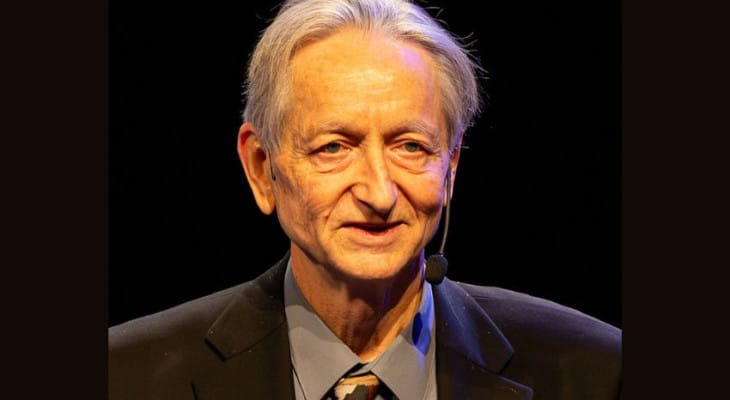
Geoffrey Hinton, the British-Canadian Nobel Prize winner who co-created the neural network technology underpinning all modern AI, is warning that 2026 will be the year artificial intelligence begins replacing workers across entire industries. In a string of recent interviews, he predicted a jobless boom, recommended becoming a plumber as one of the safest career bets, and put the odds of AI-driven human extinction within 30 years at 10 to 20 percent.
Hinton’s warns about 2026 being the year when AI will begin replacing workers across entire industries. In a string of recent interviews, he predicted a jobless boom, recommended becoming a plumber as one of the safest career bets, and put the odds of AI-driven human extinction within 30 years at 10 to 20%.
Geoffrey Hinton, the British-Canadian computer scientist whose foundational work on neural networks earned him the title Godfather of AI, a Turing Award in 2018, and the Nobel Prize in Physics in 2024, is sounding his most urgent alarms yet about what artificial intelligence will do to the workforce and to humanity itself in 2026 and beyond.
At 77, Hinton is no longer bound by corporate guardrails. He resigned from Google in May 2023 after a decade at the company specifically so he could speak freely about the dangers of the technology he helped create. Since then, his warnings have grown sharper with each passing month.
In an interview on CNN’s State of the Union, broadcast in late December 2025, Hinton was asked for his predictions for 2026. His answer was unambiguous.
“I think we are going to see AI get even better,” he said. It’s already extremely good, and we are going to see it having the capabilities to replace many, many jobs, Hinton added. “AI is already able to replace jobs in call centers, but it’s going to be able to replace many other jobs.”
He explained the mechanism behind AI’s accelerating capabilities in practical terms: Each seven months or so, it gets to be able to do tasks that are about twice as long. That means software engineering projects that once required a full hour of human work can now be completed by AI in minutes. Within a few years, he predicted, tasks requiring a full month of human engineering effort will be done by AI with dramatic consequences for the software industry. And then there will be very few people needed for software engineering projects,” he said.
Economists have a name for what Hinton is describing: a jobless boom, a period in which corporate productivity rises sharply but hiring does not follow, as companies replace workers with automation rather than expanding their headcount. Microsoft, Meta, and Google are already widely reported to be streamlining operations in this way. Hinton’s concerns extend beyond which jobs will survive. He is equally alarmed by who will benefit from the productivity gains that AI makes possible and his answer is pointed. In a society which shared out things fairly, if you get a big increase in productivity, everybody should be better off,” he said in the Diary of a CEO podcast. “But if you can replace lots of people by AIs, then the people who get replaced will be worse off.”
Speaking to the Financial Times in September 2025, Hinton said, “What is actually going to happen is rich people are going to use AI to replace workers. It’s going to create massive unemployment and a huge rise in profits. It will make a few people much richer and most people poorer. That’s not AI’s fault. That is the capitalist system.”
Hinton describes himself as a socialist and has long argued that the benefits of AI will require active redistribution by governments to prevent a catastrophic widening of inequality. In the absence of regulation, he believes the gains will flow overwhelmingly to the companies and shareholders who own the AI systems not to the workers who are displaced by them.
Just leaving it to the profit motive of large companies is not going to be sufficient to make sure they develop it safely,” he has said. Hinton further said that the only thing that can force those big companies to do more research on safety is government regulation
Hinton’s warnings carry particular weight in the Indian context. The India AI Impact Summit 2026 in New Delhi attended by the CEOs of OpenAI, Google DeepMind, and Anthropic drew billions of dollars in AI investment commitments and was celebrated as a turning point for India’s technology ambitions. Yet speakers at the same summit acknowledged the unresolved question: what happens to India’s workforce of hundreds of millions of people, many in white-collar and services roles, as AI assumes more of those tasks?
Do not Miss:
1. OpenAI is Hiring Research Communications Manager
2. Anthropic AI Jobs in Bengaluru: Check Open Roles