© 2026 NervNow™. All rights reserved.

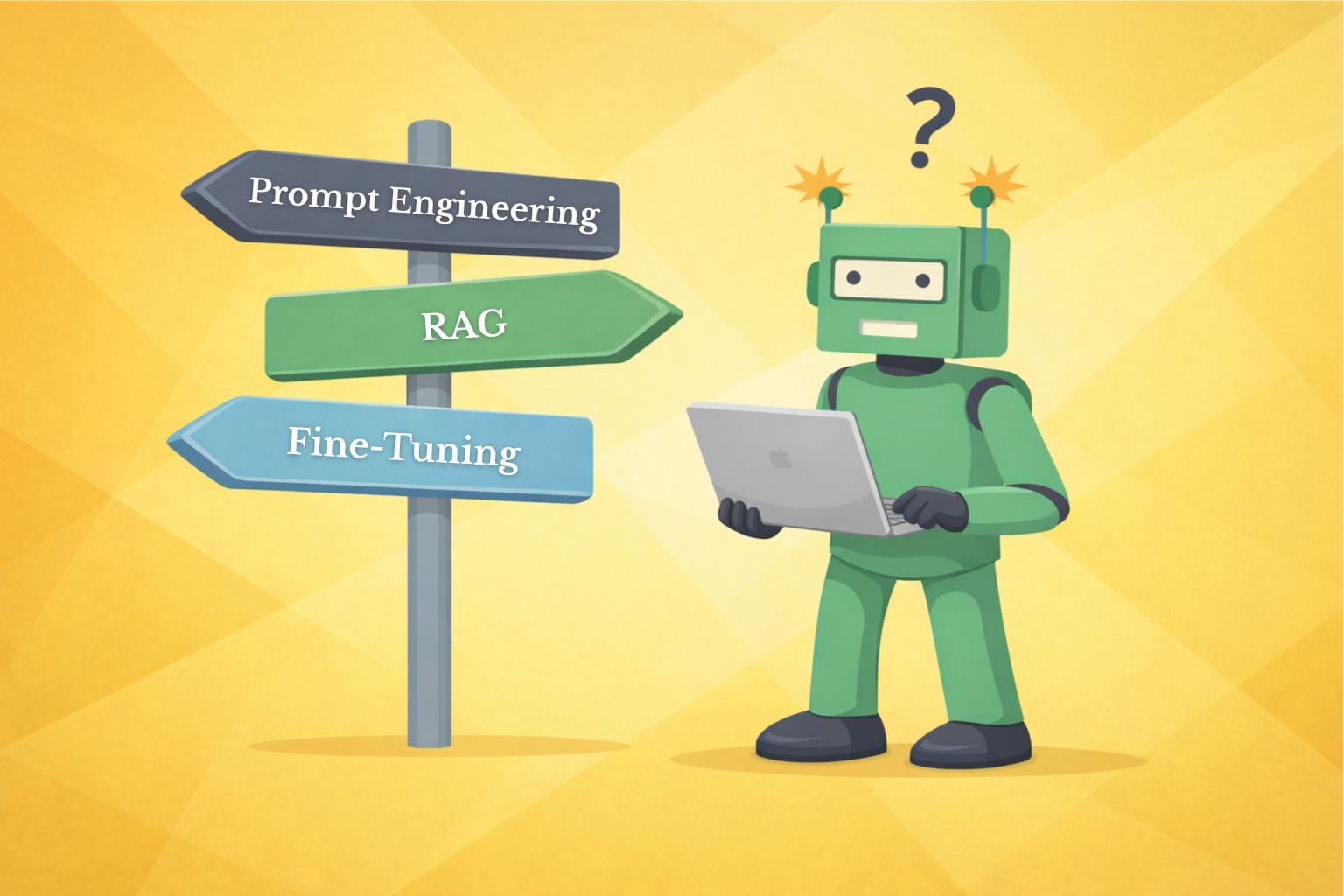

Prompts, RAG, or Fine-Tuning? The AI Stack Decision Most Teams Get Wrong
ksheshkumar Ajaykumar Shah, Founder & CEO, Cogniify.ai, writes on why most enterprise AI teams choose wrong between fine-tuning, prompt engineering, and RAG, and how understanding the right architecture for each can turn AI from an expensive experiment into a scalable business tool.
Companies are investing heavily in AI and getting very little back. Most teams reach for the wrong tool, in the wrong order, and by the time they realize it, they have already built something that cannot scale. Aksheshkumar Ajaykumar Shah, Founder & CEO, Cogniify.ai, writes on why most enterprise AI teams choose wrong between fine-tuning, prompt engineering, and RAG, and how understanding the right architecture for each can turn AI from an expensive experiment into a scalable business tool.
As artificial intelligence gets more and more involved in how companies work, many organisations face a fundamental question: how should we design AI systems to get reliable and scalable results? Prompt engineering, retrieval-augmented generation, and fine-tuning are often discussed as competing approaches. The real issue is that most teams do not understand how these approaches fit into the bigger picture of AI architecture.
Understanding how these components work together is what ultimately determines whether an AI system becomes a scalable business tool or remains an expensive experiment. For C-suite leaders making decisions about AI investment, this distinction is consequential. Choosing the wrong approach does not just slow progress. It consumes capital, creates technical debt, and produces systems that cannot adapt as the business evolves.
A common mistake companies make is treating intelligence deployment as a “knowledge project” — believing that success depends mostly on putting knowledge into a model. As a result, teams reach for fine-tuning when what they really need is to build systems that can retrieve and process company data in real time. This is a misallocation of resources. It produces AI applications that work narrowly, degrade quickly, and require constant maintenance to stay relevant.
Each of these three techniques has a specific role. When companies understand those roles clearly, they stop wasting investment and start building systems that actually work.
Prompt Engineering: The sensing layer
Prompt engineering is the first step in working with large language models. It is about structuring inputs so the model understands what we want and can produce the right outputs. When done well, prompts guide how the model reasons and define what a good response looks like.
This works well for tasks where the model already has the general knowledge required to reason through the problem. Summarizing customer support transcripts, generating reports from meeting notes, categorizing documents, in all these cases, the model already has what it needs. Prompts help it apply that knowledge with the right framing and precision.
Think of prompt engineering the way you would brief a highly capable new executive hire. They arrive with broad expertise and strong reasoning ability. Your job is to give them the right context, the right framing, and clear expectations. Done well, they deliver consistently. Done poorly, even the strongest hire produces outputs that miss the mark.
Where many teams go wrong is believing that prompt engineering alone is sufficient for enterprise AI. Models do not have up-to-date information about what is happening inside your company. Even the most carefully designed prompt cannot compensate for missing context. An AI system that cannot access live company data will always operate on an incomplete picture of reality, and the decisions it supports will reflect that gap. At scale, that gap becomes a liability.
Retrieval-Augmented Generation: The industrial source of truth
Retrieval-augmented generation or RAG, is what most companies need when they move AI from experimentation into operations. Instead of relying solely on what the AI learned during training, RAG systems retrieve the information they need from external sources and add it to the model’s reasoning in real time. The model recalls, looks things up, and then thinks.
This matters most in environments where the ground truth changes continuously. In healthcare, finance, and manufacturing, conditions shift daily. Inventory levels change, clinicians write new notes, companies sign new contracts. An AI system that cannot access current information is not a decision-support tool. It is a well-written summary of the past.
For senior leaders, the practical implication is simple. Without RAG, your AI is reasoning from a snapshot of the world taken at the point of training. It has no visibility into your current operations, your live customer data, or what changed last week. RAG closes that gap. It gives the AI access to the information that actually governs today’s decisions.
When companies implement RAG properly, they also gain something that matters enormously at the leadership level: accountability. Because the AI is reasoning over retrievable, verifiable sources, its outputs can be traced and audited. That is the foundation on which trust in an AI system is built, and trust is what allows AI to move from a pilot into a core operational capability. Organizations that skip this foundation often find themselves rebuilding from scratch after a high-profile error erodes confidence in the system entirely.
Fine-Tuning: Teaching intelligence the nuances
Fine-tuning is the most misunderstood technique in enterprise AI, and the misconception almost always runs in the same direction. Teams assume it is a mechanism for adding new information to a model. It is not. Fine-tuning changes how a model behaves. It does not change what a model knows.
Fine-tuning is the right tool when you need a model to consistently adopt a specific tone, follow domain-specific formatting conventions, understand proprietary terminology, or respond in ways that match your organisation’s standards. A legal firm might fine-tune so outputs conform to precise drafting conventions. A healthcare company might fine-tune so clinical language is handled with the right register and precision. The goal is behavioral consistency; teaching the model the nuances of how your organization communicates and works.
The problem arises when companies use fine-tuning as a substitute for live data retrieval. Baking facts into a model creates a system that is confident and consistent, right up until those facts change. When they do, the model continues to produce outputs with the same confidence, now based on outdated information. Catching and correcting this requires another round of expensive retraining. The cycle is difficult to sustain and easy to underestimate.
For leaders evaluating AI investment, this has a direct budget implication. Fine-tuning is resource-intensive and requires ongoing maintenance. It should be reserved for situations where behaviour and style genuinely cannot be achieved through well-designed prompts and live data retrieval. Applied in the right context, it adds real value. Applied as a shortcut to avoid building proper data infrastructure, it is one of the most common and costly mistakes in enterprise AI.
The architecture that actually delivers results
The best AI systems use all three techniques, in the right order, for the right reasons. Prompt engineering establishes how the model reasons and what its outputs should look like. RAG supplies the live, domain-specific information the model needs to reason accurately. Fine-tuning, where warranted, trains the model on the conventions and nuances of how your organization works.
Each layer depends on the one beneath it. A fine-tuned model without a RAG layer is well-behaved but uninformed. A RAG system without thoughtful prompt engineering retrieves the right information but reasons over it poorly. Prompt engineering without access to live data produces responses that are coherent but disconnected from operational reality.
Companies that understand how these components relate to each other stop making isolated tool decisions and start making architectural ones. That shift matters. Isolated tool decisions optimize for the problem in front of you. Architectural decisions build systems that can handle the problems you have not encountered yet.
AI is no longer a technology question for most organizations as it begins to get more strategic and operational. The companies that will lead over the next decade are not necessarily those with access to the best models; those are available to everyone. They are the ones whose leaders understand how to build the infrastructure around those models: the data flows, the retrieval layers, the behavioural guardrails. That understanding starts with knowing what each tool is actually for.
Author’s bio: Aksheshkumar Shah is Co-Founder and CEO of Cogniify.ai, a stealth-mode enterprise AI venture, and has held senior machine learning roles at Google, C3 AI, Fractal, and VideoAmp. He specializes in building production-grade intelligent systems across NLP, LLM optimisation, and industrial AI, with a track record of delivering multimillion-dollar impact in enterprise environments.
MORE ON AI TOOLS
OpenAI Launches GPT-5.4, Its Most Advanced Work Model Yet
Without System Maturity, AI Remains Just a Tool: Hector’s Meher Patel on What Brands Keep Getting Wrong
Nano Banana 2 is Google’s Fastest Image AI Yet
LLM SEO: How to Get Your Brand Mentioned by AI?
AI-Backed Teacher App 2.0 Launched