© 2026 NervNow™. All rights reserved.


Top 20 AI Companies in India to Watch in 2026
From sovereign foundation models and GPU clouds to medical imaging and quantum computing, a field-by-field look at the top 20 Indian AI companies in India with the funding, traction, and technical depth to matter beyond this year.
From sovereign foundation models and GPU clouds to medical imaging and quantum computing, a field-by-field look at the Indian AI companies with the funding, traction, and technical depth to matter beyond this year.
India’s AI ecosystem has moved faster in the last 18 months than in the preceding decade. The India AI Impact Summit in February 2026 drew investment commitments and partnership announcements at a scale that would have seemed implausible even two years ago, and positioned the country as a credible sovereign AI hub for the first time. The IndiaAI Mission has deployed capital, compute, and government contracts to companies building foundational infrastructure. The private capital followed further. Indian AI startups raised $780.5 million in 2024 alone, a 39.9% increase year on year, and momentum has continued into 2026.
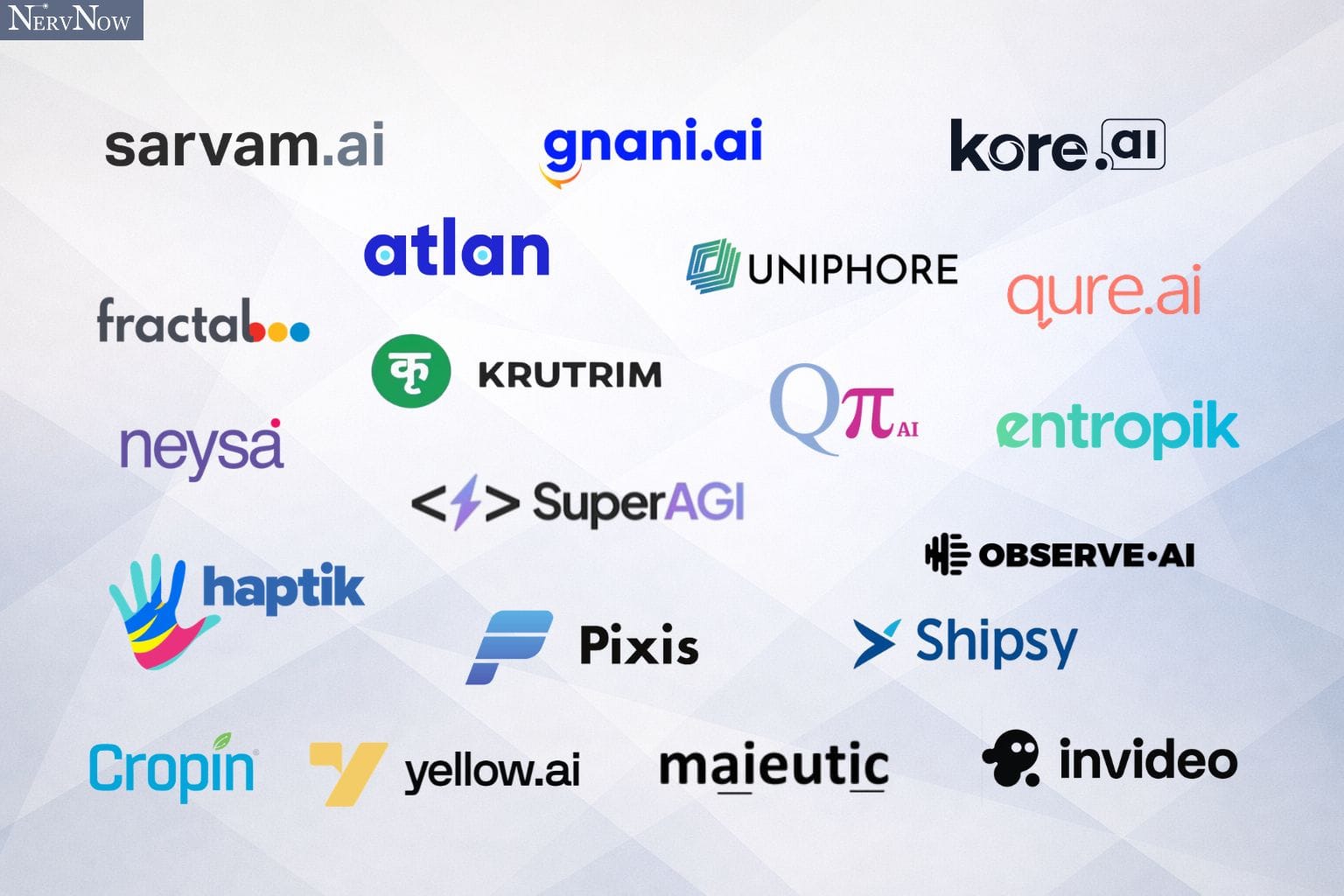
This list covers 20 companies across foundation models, enterprise AI, healthcare, infrastructure, agriculture, and design tooling, selected on four criteria: funding quality and investor interest, product innovation and technical differentiation, founder background and domain depth, and demonstrable revenue or deployment traction. The editorial scope excludes IT services majors and companies whose AI amounts to a layer on top of a third-party product. Every company included has AI as a core.
Sarvam AI
Founded: 2023
Founders: Vivek Raghavan, Pratyush Kumar
Funding: $53M (Lightspeed, Peak XV, Khosla Ventures)
Sector: Sovereign AI/Foundation Models
The most consequential Indian AI story of the moment. Sarvam was selected by the Ministry of Electronics and IT in April 2025 to build India’s first sovereign large language model under the IndiaAI Mission. At the India AI Impact Summit in February 2026, the company unveiled Sarvam-30B and Sarvam-105B, both trained from scratch, both supporting all 22 official Indian languages, and both competitive on global benchmarks. Within days of launching its consumer app Indus, downloads crossed 50,000. Sarvam has also signed MoUs with Tamil Nadu and Odisha to establish AI capacity hubs and research parks. Its Vision OCR scored 84.3% on olmOCR-Bench, outperforming both Gemini and ChatGPT on multilingual document understanding. Both founders come from AI4Bharat at IIT Madras, the academic institution widely credited as the bedrock of India’s indigenous NLP research.
Note: The company’s total funding stands at $53M across its seed and Series A rounds, with the founders on record indicating a larger raise is on the horizon.
ALSO READ: Nvidia’s New AI Supergroup Has 8 Players, India’s Sarvam Is One of Them
Krutrim
Founded: 2023
Founders: Bhavish Aggarwal
Funding: ~$75M (Z47, formerly Matrix Partners India)
Sector: Foundation Models/AI Infrastructure
India’s first AI unicorn, valued at $1 billion within weeks of its first funding round. Krutrim builds multilingual LLMs and an AI cloud platform designed for Indian-context deployment, with its models supporting over 22 Indian languages. In mid-2025, it launched Kruti, an agentic assistant capable of handling multi-step tasks in Indian languages. The company has also stated ambitions to build India’s first homegrown AI chip and has tested an early inference chip internally. That said, 2025 was operationally turbulent, multiple rounds of layoffs, stalled fundraising, and several senior leadership exits. The infrastructure cloud business is live; traction remains limited compared to global alternatives. Bhavish Aggarwal’s ability to mobilise capital and attention is not in doubt. Execution consistency is what Krutrim needs to prove next.
DO NOT MISS: With Krutrim, Has ‘Make in India’ in AI Finally Arrived?
Uniphore
Founded: 2008
Founders: Umesh Sachdev, Ravi Saraogi
Funding: ~$958M (SoftBank, March Capital, others)
Sector: Conversational AI/Enterprise CX
Among the most heavily funded AI companies ever to come out of India. Uniphore builds voice AI, emotion AI, and automation platforms for enterprise customer experience, with deployments spanning contact centres across banking, telecom, and insurance. Its technology supports multiple Indian and global languages, and the company has operations across the US, Europe, and Southeast Asia. Founders Umesh Sachdev and Ravi Saraogi met at IIT Madras and have built Uniphore into one of the few Indian AI companies with genuine enterprise scale outside India.
Kore.ai
Founded: 2013
Founders: Raj Koneru
Funding: $234M Series D (FTV Capital, NVIDIA, others)
Sector: Enterprise AI/Agentic Platforms
Raj Koneru built Kore.ai into one of India’s most significant enterprise AI platforms, with its 2024 round becoming one of the largest single AI funding events in Indian startup history. NVIDIA’s participation shows hardware-software convergence at scale. The platform enables enterprises to build AI agents for customer service, HR, and IT operations, and has over 400 enterprise customers globally. Its Hyderabad roots have helped anchor the city as a credible AI hub alongside Bengaluru.
Qure.ai
Founded: 2016
Founders: Prashant Warier
Funding: ~$123M (360 One, HealthQuad, Peak XV, others)
Sector: Healthcare AI/Medical Imaging
Qure.ai has screened over 39 million patients across 105 countries using deep learning models for chest X-ray and CT scan interpretation. Its qXR product received regulatory clearance for paediatric TB screening in October 2025, expanding its clinical footprint. The company is targeting an IPO within the next two years. What makes Qure.ai credible in a space often dominated by hype is its WHO-assessed deployment track record in resource-constrained environments: from Indian district hospitals to clinics in sub-Saharan Africa. Its latest Series D round in September 2024, led by 360 One, brought total disclosed funding to approximately $123M.
Fractal Analytics
Founded: 2000
Founders: Srikanth Velamakanni, Pranay Agrawal
Funding: $855M approx (TPG, Apax Partners, others); listed February 2026
Sector: Enterprise AI/Decision Intelligence
One of India’s oldest and most established AI companies, and now a public one. Fractal completed its IPO in February 2026, listing on both the BSE and NSE. It serves Fortune 500 companies across financial services, retail, healthcare, and consumer goods with AI-powered analytics and decision intelligence platforms. Annual revenue stands at INR 27.6 billion for the fiscal year ended March 2025, with Q3 FY26 revenue at INR 854.4 crore, 21% growth year on year, and a PAT of INR 100.1 crore. In May 2025, it launched Fathom-R1-14B, an open-source reasoning model it claims outperforms OpenAI’s o1-mini on structured reasoning tasks, and is building what it describes as India’s first large-scale reasoning model under the IndiaAI Mission.
Observe.AI
Founded: 2017
Founders: Swapnil Jain, Akash Singh, Sharath Keshava Narayana
Funding: $214M (Zoom, Y Combinator, Menlo Ventures, Nexus)
Sector: Contact Center AI/Conversational Intelligence
Observe.AI applies AI to contact center operations, providing real-time agent assistance, automated QA, and conversation analytics for enterprise customers. In March 2025, it acquired text-to-speech startup Dubdub.ai to deepen its conversational AI stack. With Y Combinator and Zoom as backers, the company has built a strong US enterprise client base from its Bengaluru and San Francisco presence. The Dubdub acquisition highlights a shift toward building end-to-end voice intelligence rather than just analysis.
Neysa
Founded: 2023
Founders: Sharad Sanghi, Anindya Das
Funding: $650M (Z47, Nexus Venture Partners, Blackstone)
Sector: AI Infrastructure/GPU Cloud
Neysa became one of the highest-profile AI infrastructure stories in India when Blackstone and other co-investors committed $600 million in early 2026, one of the largest private equity bets on an Indian AI company to date. The company provides GPU cloud infrastructure and MLOps services, enabling enterprises and startups to train and deploy AI workloads without dependence on global hyperscalers. Founders Sharad Sanghi and Anindya Das bring backgrounds from Microsoft Azure and Nutanix. With plans to deploy over 20,000 GPUs, Neysa is positioning as India’s sovereign compute layer.
Yellow.ai
Founded: 2016
Founders: Raghu Ravinutala, Jaya Kishore Reddy Gollareddy, Rashid Khan
Funding: Over $102M (Sapphire Ventures, WestBridge Capital)
Sector: Conversational AI/Enterprise Automation
Yellow.ai has built one of the more globally distributed conversational AI platforms out of India, with over 1,000 enterprise clients and operations in 85+ countries. Its omnichannel bots handle voice and chat in over 100 languages, with strong penetration in BFSI, retail, and telecom. The platform’s depth in enterprise automation, rather than consumer chat, has kept it relevant as the generative AI shift reshapes the conversational layer.
Pixis
Founded: 2018
Founders: Shubham Mishra, Vrushali Prasade, Harikrishna Valiyath
Funding: $209M (General Atlantic, Celesta Capital, Chiratae)
Sector: Marketing AI/AdTech
Pixis provides a codeless AI infrastructure platform for marketing performance, helping brands optimize digital advertising, automate creative generation, and orchestrate campaign budgets in real time. Backed by General Atlantic, it ranked 785 on the 2025 Inc. 5000 list and won a MarTech Breakthrough Award for AdTech innovation. The company has expanded its leadership team with Asia-Pacific focused hires, showing growth intent beyond its existing US and Indian markets.
InVideo
Founded: 2019
Founders: Sanket Shah, Anshul Khandelwal
Funding: ~$52.5M (Tiger Global, Sequoia)
Sector: Generative AI/Video Creation
InVideo evolved from a web-based video editor into a text-to-video generative AI platform. Users describe a concept in natural language; the platform handles scripting, scene selection, voiceover, and editing. The product has found significant traction among small businesses, creators, and digital marketers who lack professional video production resources. Its consumer-facing generative AI approach sets it apart from the enterprise focus that dominates most of this list.
QpiAI
Founded: 2019
Founders: Dr. Nagendra Nagaraja
Total Funding: $38.5M approx (Avataar Ventures, National Quantum Mission)
Sector: Quantum-AI/Deep Tech Infrastructure
QpiAI occupies a unique position at the intersection of AI and quantum computing, a combination few Indian startups have pursued at this level. Its QpiAI Pro platform deploys AI solutions in production environments, while its hardware division manufactures quantum processors, cryogenic controllers, and quantum compute architecture. With subsidiaries in the US and Finland, the company has a genuinely global footprint. Backed under the National Quantum Mission (NQM) framework, QpiAI represents the infrastructure layer India will need as quantum-classical hybrid computing matures.
SuperAGI
Founded: 2022
Founders: Ishaan Bhola
Funding: $15M (Newlands VC and Kae Capital)
Sector: Agentic AI/Open-Source LAMs
SuperAGI transitioned in July 2025 from a marketing platform to a full agentic AI platform, building open-source Large Action Models that allow enterprises to construct custom AI agents for marketing, sales, and support workflows. Its open-source positioning makes it one of the few Indian AI companies actively contributing to the global developer ecosystem rather than building behind closed APIs.
Cropin
Founded: 2010
Founders: Krishna Kumar, Kunal Prasad
Funding: $46.4M+ (Google, ABC Impact, Chiratae, others)
Sector: AgriTech AI/Precision Farming
Cropin has built one of the most substantive AI applications in Indian agriculture, combining satellite imagery, weather data, and machine learning to support crop health monitoring, yield prediction, and harvest planning. Its platform is deployed across 103 countries, covering over 30 million acres of farmland. In a sector where most AI applications remain pilots, Cropin has reached production scale across markets that range from India to sub-Saharan Africa.
Gnani.ai
Founded: 2016
Founders: Ganesh Gopalan, Ananth Nagaraj, Bharath Shankar
Funding: $7.72M (to date); (Info Edge Ventures)
Sector: Voice AI/Multilingual Speech
Gnani.ai launched its own multilingual voice model, Vachana TTS, in February 2026 at the India AI Impact Summit, directly competing with Sarvam on the voice layer with zero-shot voice cloning across 12 Indian languages. The company specializes in speech recognition, voice biometrics, and multilingual voice automation across banking, telecom, and enterprise customer support. Its relatively modest funding belies its technical depth; Gnani has been building in voice AI since well before generative models made the space fashionable.
Entropik
Founded: 2017
Founders: Ranjan Kumar
Funding: $35M total (Alteria Capital, Bessemer Venture Partners, others)
Sector: Emotion AI/Consumer Insights
Entropik applies AI to decode human emotional and cognitive responses using facial coding, eye tracking, and brainwave analysis, primarily for consumer research and advertising effectiveness. Its Affect Lab platform helps brands understand how audiences actually respond to content rather than what they report in surveys. With several investor backing, the company has built a differentiated niche in a market where most AI insight platforms remain surface-level.
Haptik
Founded: 2013
Founders: Aakrit Vaish, Swapan Rajdev
Funding: Acquired by Reliance Jio (2019); ~$12M raised prior
Sector: Conversational AI/Enterprise Chatbots
Haptik was one of India’s earliest conversational AI companies and became strategically important when Reliance Jio acquired it in 2019. It now powers intelligent virtual assistants for enterprise customers across telecom, financial services, and e-commerce, with access to Jio’s distribution scale. For enterprises deploying conversational AI across India’s telecom-heavy ecosystem, Haptik’s positioning within Reliance gives it network advantages that independent startups cannot replicate.
Maieutic Semiconductor
Founded: 2025
Founders: Gireesh Rajendran, Ashish Lachhwani, Rakesh Kumar, Krishna Sankar M
Funding: $4.2M (Endiya Partners, Exfinity Venture Partners)
Sector: AI for Semiconductor Design/EDA
One of the youngest companies on this list, and one of the most technically distinctive. Maieutic is building a GenAI-powered copilot for analog IC design, a process that remains largely manual despite decades of automation in digital chip design. Its platform targets architecture selection, anomaly detection, and simulation stages of the design process, aiming to compress a 15 to 24-month design cycle. Founded by former engineers from Qualcomm and Broadcom, it represents India’s first serious attempt at AI for electronic design automation.
Shipsy
Founded: 2016
Founders: Soham Chokshi, Sahil Arora, Dhruv Agarwal, Himanshu Gupta
Funding: $30M+ (Info Edge, Sequoia Surge, A91 Partners)
Sector: Supply Chain AI/Logistics
Shipsy applies AI to cross-border and last-mile logistics, helping enterprises optimise carrier selection, route planning, and shipment tracking across complex global supply chains. Its platform is used by logistics operators, retailers, and manufacturers in over 20 countries. In an AI landscape dominated by software and language models, Shipsy represents the commercially proven category of AI applied to physical operations.
Atlan
Founded: 2019
Founders: Prukalpa Sankar, Varun Banka
Funding: $105M (Insight Partners, Salesforce Ventures, others)
Sector: Data Intelligence/AI Governance
Atlan builds a data collaboration and governance platform used by data teams at companies like Nasdaq, Unilever, and WeWork. As enterprises globally wrestle with how to govern AI-generated data pipelines, Atlan’s metadata management and lineage tracking capabilities have become increasingly relevant. Its $105M round in May 2024 was one of the larger enterprise data infrastructure deals in Indian startup history, and Salesforce Ventures’ participation indicates strategic alignment with the broader enterprise software ecosystem.
Editorial Note: Funding figures are drawn from public sources including company announcements, Tracxn, Crunchbase, and Inc42, and reflect total disclosed funding as of March 2026 where available. While we have made every effort to ensure accuracy, figures may vary across sources or may have changed since the time of research. In case of a discrepancy, write to us at editorial@nervnow.com and we will make the necessary corrections.
Researched and written by NervNow Editorial. nervnow.com
RELATED READS
Nebius-Meta $27B Deal Highlights Big Push in AI Infrastructure Expansion
How to Evaluate AI Vendor Claims: A Technical Guide for CTOs and AI Leaders
InvestorAi Appoints Gopinath Natarajan as President & Head of Markets
Frore Hits $1.64B Valuation on AI Chip Cooling Breakthrough
UAE-Based Kudwa Raises $1.1M for the Next Layer of Finance AI