© 2026 NervNow™. All rights reserved.

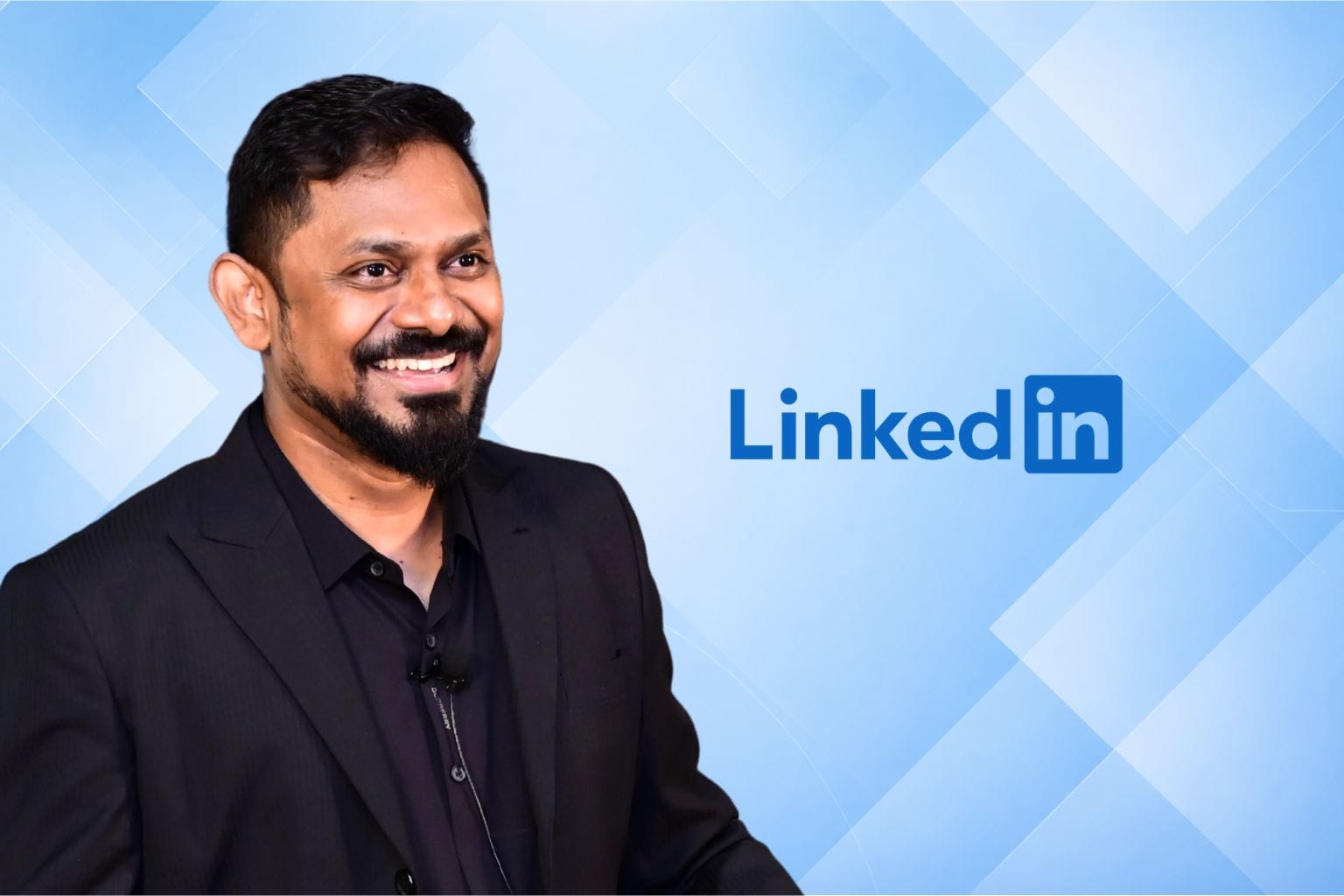

LinkedIn’s Guna Grace on India’s Enterprise AI Gap: Deep at the Top of the Funnel, Shallow Everywhere Else
Guna Grace, Head of Sales, Enterprise at LinkedIn Talent Solutions, spoke about where AI in hiring is working, what most organizations get wrong about AI-driven retention tools, and more.
Interview
›
AI in HR
›
Enterprise Talent
NervNow Interview Series
The AI Is Ready. The Organization Is Not.
Guna Grace, Head of Sales, Enterprise at LinkedIn Talent Solutions, spoke with NervNow about where AI in hiring is genuinely working, what most organizations get wrong about AI-driven retention tools, how AI has changed pipeline management and enterprise sales, and why he believes the final hiring decision must always stay with a human.
G
Guna Grace
Head of Sales, Enterprise, LinkedIn Talent Solutions · South India, Sri Lanka & Maldives
Guna Grace leads enterprise sales for LinkedIn Talent Solutions across South India, Sri Lanka, and the Maldives. He chairs the Diversity, Inclusion and Equity Committee at the Southern India Chamber of Commerce and Industry and serves as an Advisor to the Global AI Forum. Over more than two decades in enterprise talent, he has partnered with C-suite leaders across BFSI, IT/ITES, manufacturing, and conglomerates on how they hire, develop, and retain talent. He publishes The Talent Compass, a newsletter on workforce intelligence.
Guna Grace has spent more than two decades at the intersection of enterprise sales and talent technology. For the past eight-plus years he has led LinkedIn Talent Solutions across South India, Sri Lanka, and the Maldives, working directly with CHROs and CEOs on workforce transformation. He chairs the DEI Committee at SICCI and advises the Global AI Forum. NervNow spoke with him about where AI in hiring is genuinely working, where it is failing, what most organizations get wrong about retention technology, and why he believes the final hiring call must always stay with a human.
AI in Hiring
NervNow
Hiring platforms have been embedding AI into talent workflows for some time now. From your conversations with CHROs and CEOs, where do you see the most genuine adoption, and where is AI still more aspiration than implementation?
Guna Grace
I have been in rooms with CHROs and CEOs for several years now, and the pattern is consistent. The most genuine adoption is at the top of the funnel: sourcing, screening, and shortlisting. Enterprises in BFSI, IT/ITES, and large manufacturing conglomerates have moved past the pilot stage here. They are using AI to surface passive candidates, reduce time-to-shortlist, and get a cleaner signal on skills fit before a human ever enters the conversation. That part is real and it is working.
Where AI is still mostly aspiration? Workforce planning and internal mobility. I have conversations every week with CHROs who will tell you they want to use AI to predict attrition and build talent pipelines from within. But when you get into the specifics, the data infrastructure is not there. The job architecture has not been updated in years. The managers do not have visibility into their team’s skill profiles. So the AI is ready. The organization is not.
The honest picture right now is: deep adoption at the top of the funnel, shallow adoption everywhere else. That gap is where the real work sits.
NervNow
Skills-based hiring has been discussed for a decade, but AI is now making it operationally possible. What does that shift look like on the ground for enterprise talent teams in India?
Guna Grace
I remember skills-based hiring being discussed when I was still at Naukri, this is an 8-years-back story. It was a good idea that nobody could operationalize at scale because the data did not exist and the process could not handle it. What AI has changed is the ability to infer skills from signals, not just self-reported resumes. Today’s talent intelligence tools can look at what someone has actually done, the projects, the titles, the career progression, and map that to skill adjacencies that a recruiter would never catch manually. That is genuinely new.
On the ground, the shift is happening in three ways. First, job descriptions are being rewritten around outcomes and skills rather than years of experience and degree requirements. Second, interview frameworks are being restructured to test for capability, not credentials. Third, assessment tools are getting better at measuring real proficiency before the offer stage.
But here is what I tell every talent team: AI can surface the right candidates. It cannot fix a hiring manager who still defaults to pedigree. The bottleneck for skills-based hiring in India is not the technology. It is the manager in the room at the final stage who has not updated how they evaluate people.
AI can surface the right candidates. It cannot fix a hiring manager who still defaults to pedigree. The bottleneck for skills-based hiring in India is not the technology. It is the manager in the room at the final stage.
NervNow
A lot of enterprise leaders are using AI to speed up hiring. But does speed sometimes work against quality of hire? How do you counsel CXOs to think about that trade-off?
Guna Grace
Speed is a proxy for efficiency, not quality. Those two things are related but they are not the same, and conflating them is one of the most expensive mistakes a talent team can make.
I have seen companies bring time-to-hire down from 45 days to 15 days with AI-assisted screening, and then watch their 90-day attrition go up because they cut human judgment out of the middle stages, not just the administrative ones. The AI was moving fast. The wrong people were still getting through.
My counsel to CXOs is this: use AI to eliminate the low-signal work, not the high-signal work. Let AI handle scheduling, initial screening, and basic skills matching. But the stage where a hiring manager sits with a candidate and evaluates culture alignment, leadership potential, and coachability cannot be compressed. That is where quality of hire lives.
The organizations doing this well are not asking how fast can we hire. They are asking where in this process does human judgment create the most value. AI accelerates everything around that question. It cannot answer it.
Workforce Intelligence
NervNow
You write about workforce intelligence in The Talent Compass. What is the gap between how most Indian enterprises currently use people data and what AI actually makes possible today?
Guna Grace
Most Indian enterprises use people data retrospectively. Headcount reports. Attrition rates after the fact. Engagement survey scores that arrive three months after the window to act has closed. The data is there but it is being used like a rearview mirror.
What AI makes possible is predictive and prescriptive intelligence. Not here is what happened to our workforce last quarter, but here is who is likely to leave in the next 90 days, here is why, and here is what intervention has worked in similar cases. Not here are our open roles, but here is where your internal talent can grow before you go to market.
The gap is significant. And the reason the gap exists is not a technology problem. Most enterprises have not decided who owns workforce intelligence. Is it HR? Finance? The CHRO? When nobody owns it, the data sits in silos and nobody acts on it. AI can close the analytical gap overnight. The organizational design problem takes longer.
NervNow
Predictive attrition tools exist. AI-driven internal mobility platforms exist. Yet retention remains a crisis for many organizations. What is going wrong in how companies are deploying these tools?
Guna Grace
The tools are being deployed as dashboards when they need to be deployed as decision-support systems. That is the fundamental problem.
A predictive attrition model tells a manager that three people on their team are in the high-risk category. If that information sits in a dashboard that the manager checks once a quarter, nothing changes. The value of prediction is entirely dependent on the speed and quality of the intervention that follows.
What I see consistently is that organizations invest in the technology and underinvest in the response infrastructure. No one has defined what a manager is supposed to do when the attrition signal fires. No one has trained managers on retention conversations. The CHRO has the data. The frontline manager, who is the person who can actually do something about it, is still operating on instinct.
Internal mobility platforms have the same problem. The platform can show an employee three roles they would be a fit for inside the organization. But if the manager blocks internal movement because they do not want to lose a high performer, the platform is decorative. Retention is a leadership behavior before it is a technology problem.
The tools are being deployed as dashboards when they need to be deployed as decision-support systems. That is the fundamental problem.
NervNow
As an advisor to the Global AI Forum, what is the conversation you find yourself having repeatedly with enterprise leaders about AI readiness in their HR and talent functions?
Guna Grace
The conversation I keep having is about what I call the readiness gap. Leaders come to these forums wanting to talk about AI features. But when you sit with them for an hour, the real issue surfaces: their data is fragmented, their HR teams have not been upskilled to work with AI outputs, and their line managers do not trust the system enough to act on what it tells them.
AI readiness in HR is not about buying the right platform. It is about three things running in parallel: clean data foundations, change management at the manager level, and clear accountability for acting on AI-generated insights.
The enterprises making real progress on this are the ones where the CHRO has a seat at the table in the technology decision, not just the implementation. When the CHRO is involved from the strategy stage, the tool gets configured for the actual problems the organization is trying to solve. When the CHRO inherits a system that IT or procurement bought, the tool does not fit the workflow, adoption falls apart, and the whole thing gets quietly shelved.
Sales, GTM, and AI
NervNow
You have sold enterprise solutions through two very different eras, Naukri in 2005 and LinkedIn today. How has AI changed the way enterprise sales itself works, beyond just the products being sold?
Guna Grace
When I joined Naukri in 2005, enterprise sales was a proximity game. You had to be physically in front of the customer. Discovery happened in the room. Pipeline was built on relationship density and manual prospecting. The playbook was about human effort and sheer coverage.
The inputs to a deal are completely different today. AI has changed three things fundamentally. First, the buyer is far more informed before they ever talk to you. They have already researched competitors, read peer reviews, and formed a view of what they need. Your discovery conversation has to go deeper because the surface questions have already been answered by a search engine. Second, pipeline management is no longer a spreadsheet discipline. AI tools are giving my team signal on where deals are likely to close, where they are stalling, and what interventions have historically worked at similar deal stages. That changes how a sales leader coaches. Third, the internal efficiency gains are real. Time that used to go to research, meeting prep, and CRM hygiene can now go to high-quality customer conversations.
What has not changed: the enterprise sales relationship is still fundamentally human. The CHRO signs a multi-million dollar contract with a person they trust, not a tool they have been shown. AI makes my team sharper. It does not replace the trust architecture that enterprise deals run on.
NervNow
When a CHRO tells you they are exploring AI for talent, what does that actually mean in practice? Is there a pattern to where organizations are in their AI journey?
Guna Grace
There is a very clear pattern. After several years of these conversations, I would put organizations in three places.
The first group is experimenting. They have bought or piloted one AI tool, usually at the top of the funnel, and they are measuring it against a narrow metric like time-to-shortlist. They are curious but not committed. The decision to scale is still somewhere in a committee.
The second group is integrating. They have moved beyond pilots and are now working through the messy organizational questions: whose job changes, what data needs to be cleaned, how do you get managers to trust the outputs. This is where most of the serious players in India are right now. It is slower than they expected and more complicated than the vendor promised.
The third group is transforming. These are the organizations where the CHRO has restructured the talent function around AI-augmented workflows. The job descriptions have changed. The team’s skills have changed. Workforce intelligence has become a strategic input into business decisions, not just an HR reporting function. This group is smaller than the market narrative suggests. Maybe 15 to 20 percent of the enterprises I work with.
When a CHRO says they are exploring, what they usually mean is they are somewhere between groups one and two, waiting for proof that the investment is worth the organizational disruption.
When a CHRO says they are exploring AI, what they usually mean is they are waiting for proof that the investment is worth the organizational disruption.
Diversity, Inclusion, and AI Risk
NervNow
You chair the DEI committee at SICCI. AI hiring tools have a documented history of encoding bias. How should enterprise leaders in India be evaluating that risk before deploying these systems?
Guna Grace
The first thing I tell leaders is this: the bias was in the data before it was in the algorithm.
AI hiring tools trained on historical decisions will amplify existing patterns. So if an organization has historically under-hired certain groups or overlooked talent from specific regions, institutions, or backgrounds, the system will learn and replicate that unless it is actively corrected. The risk here is not just technical. It directly impacts fairness and representation.
For enterprise leaders in India, I would put three questions on the table before deploying any AI in hiring. First, what data was this model trained on, and does it truly reflect the diversity of your talent pool? Second, can the vendor demonstrate audited outcomes across gender, age, geography, and other underrepresented groups, not just accuracy, but fairness? Third, what is your override and appeals process when a candidate or hiring manager challenges an AI-driven recommendation? Because inclusion also means giving people a voice in the system.
The organizations doing this well are treating AI hiring like a financial model, with audit layers, governance, and a human in the loop for every high-stakes decision. Because without that, you are not just scaling hiring. You are scaling bias.
NervNow
There is a tension between AI-driven efficiency in hiring and the human judgment required for inclusive hiring decisions. Where do you draw that line?
Guna Grace
My position is clear: AI should never make the final call on a person.
AI can rank. It can screen. It can surface candidates who would have been missed in a purely manual process. In some cases, AI actually improves inclusion because it removes the unconscious pattern-matching that happens when a hiring manager defaults to candidates who look and sound like people already in the organization. There is real evidence for that benefit and I take it seriously.
But inclusion is ultimately about the quality of the decision made by a human being who has looked at a whole person, not a skills profile. The moment you automate the hiring decision itself, you have also automated accountability. When a bad hire happens, someone has to own it. When an excluded candidate has grounds to question the process, someone has to answer. That accountability chain requires a human to be genuinely in the decision, not just signing off on what the algorithm recommended.
The line I draw is this: AI is a tool for better human decisions, not a replacement for them. In inclusive hiring especially, the human judgment layer is not a bottleneck to optimize away. It is the point.
My position is clear: AI should never make the final call on a person. The moment you automate the hiring decision itself, you have also automated accountability.
Disclaimer: The views expressed in this interview are personal to Guna Grace and do not represent the positions of LinkedIn or NervNow.
Do Not Miss These Interviews
- Ekgaon’s Vijay Pratap Singh on India’s Agri Paradox: Data and AI Exist, Intent Doesn’t
- SportsEdTV CEO Victor Bergonzoli on How AI Is Turning Athlete Data Into a Financial Risk Model
- DPDzero Founder Ranjith BR on What 10 Million AI Insights Reveal About Debt Collections in India
- Georg Langlotz, UBS: India Does Not Have an AI Talent Problem, It Has an AI Ambition Problem
- Lovable’s Whitney Menarcheck on AI Opportunity, Community-First Thinking, and More
Sources
- LinkedIn Talent Solutions, enterprise product portfolio. Available at business.linkedin.com.
- Southern India Chamber of Commerce and Industry (SICCI), DEI Committee.
- Global AI Forum, advisory board membership, 2026.