© 2026 NervNow™. All rights reserved.


How ClimateAi is Giving Food Companies a Six-Month Head Start on Climate Disruption
ClimateAi uses machine learning on satellite, oceanic, and atmospheric data to help food and agribusiness companies see crop yield disruptions coming months before they happen. Its customers include Dole, Driscoll's, Suntory, and Oatly. Almost no one outside the industry has heard of it.
AI Making a Difference | Series No. 2 | Climate & Agriculture AI
How ClimateAi Is Helping the World’s Largest Food Companies Outsmart Climate Disruption
ClimateAi uses machine learning on satellite, oceanic, and atmospheric data to help food and agribusiness companies see crop yield disruptions coming months before they happen. Its customers include Dole, Driscoll’s, Suntory, and Oatly. Almost no one outside the industry has heard of it.
$38M
Total funding raised across three rounds
Series B announcement, April 2023
5x
ARR growth in the 18 months before Series B
Series B announcement, April 2023
35+
Enterprise customers at Series B close
Series B announcement, April 2023
2022
Named TIME Magazine Best Invention of the Year
TIME Magazine, 2022
Disclaimer: This article has been researched and produced by the NervNow editorial and research team. All data points and figures reflect information available at the time of publication. This brief is for informational purposes only and does not constitute financial, investment, or strategic advice.
Background
The Problem
When a drought cuts a harvest short or a late frost wipes out a berry crop, the world’s largest food companies tend to find out at the worst possible moment: supply has already fallen short, contracts are already failing, and prices are already moving against them. Procurement teams absorb the disruption, margins compress, and the event gets written off as an unforeseeable consequence of bad weather. The assumption that it was unforeseeable is the part ClimateAi disputes.
Climate signals carry information about growing conditions months before those conditions materialize in the field. Sea surface temperatures, atmospheric pressure patterns, and oceanic salinity readings are mathematically connected to what will happen to a corn crop in Iowa or a berry harvest in Baja California long before the season begins. The challenge has always been integrating enough of these data sources, at sufficient resolution and speed, to produce a forecast specific enough for a procurement team to act on. That is the problem ClimateAi set out to solve when it was founded in San Francisco in 2017.
Origins
The Founders
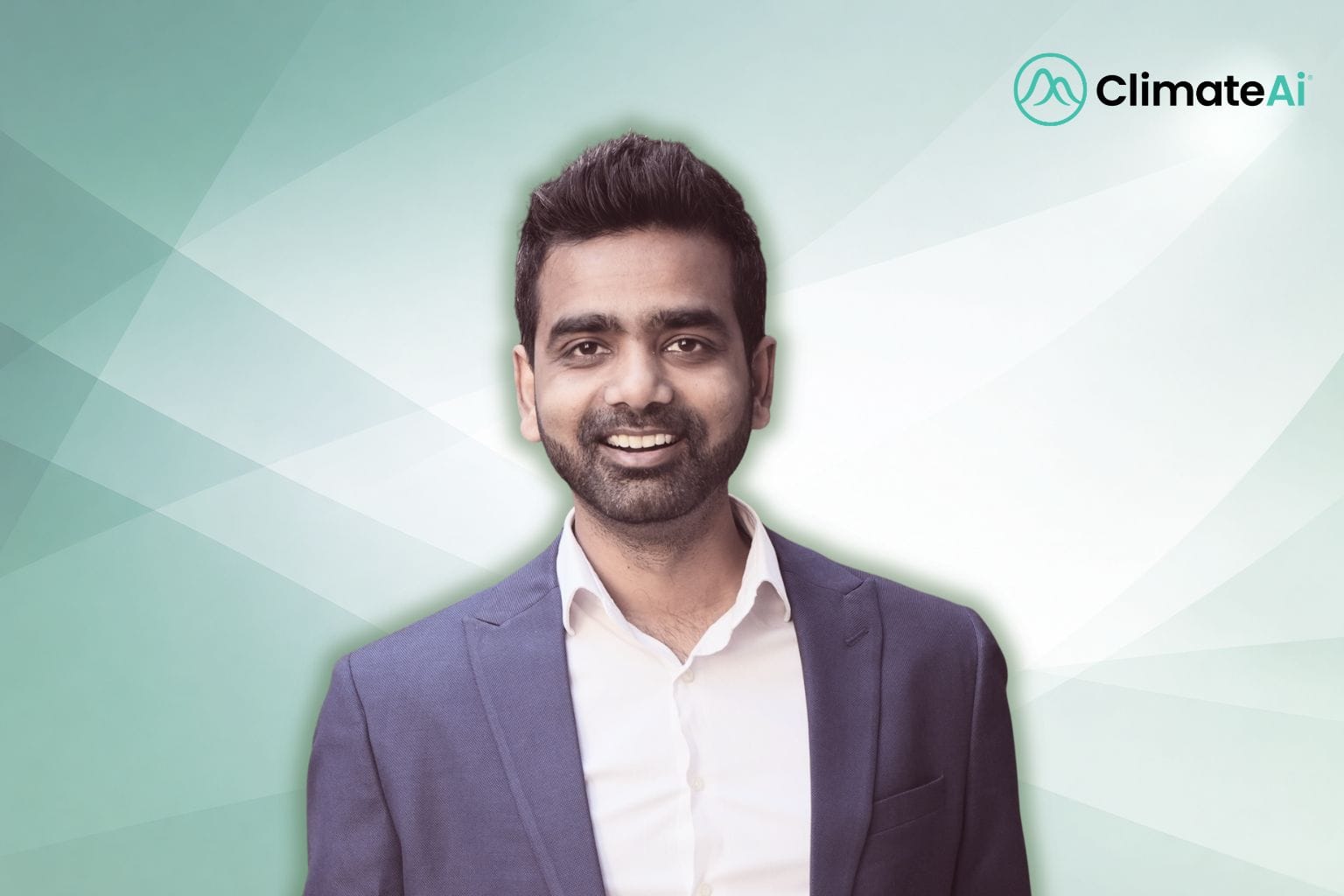
ClimateAi was co-founded by Himanshu Gupta and Max Evans while both were completing MBAs at Stanford University. The two built the company out of a shared conviction about a problem they each understood personally, from opposite ends of the global food supply chain.
Gupta grew up in Vrindavan, in northern India, in a multigenerational household where water scarcity and food price inflation were lived realities rather than policy concerns. Before Stanford, he worked for the Government of India drafting the renewable energy chapter of the country’s 12th National Five-Year Plan, then went on to work with former US Vice President Al Gore on climate policy and co-authored research with economist Lord Nicholas Stern on India’s low-carbon growth path. Forbes named him to its 30 Under 30 India list in 2016 for his work in energy and climate. In 2023, Business Insider listed him among the top 100 people in artificial intelligence globally. Bloomberg included him on its 2024 Catalysts List of leaders driving transformative change.
Evans grew up in Ecuador, the son of a pineapple farmer, and spent his childhood helping his father harvest crops for the same multinational food companies that would later become ClimateAi’s customers. He brought to the company a firsthand understanding of what climate volatility costs at the farm level, measured not in index points but in income. Evans has since retired from the company.
“
One co-founder grew up where water scarcity shaped daily life. The other harvested crops as a child for the companies that are now paying customers. The platform they built carries both of those perspectives.
Platform
What ClimateAi Does
ClimateAi’s platform, ClimateLens, ingests data from satellite sensors, radar stations, weather stations, and oceanic buoys, including sea surface temperature and salt content readings, and combines it with output from major meteorological agencies including NOAA and the European Centre for Medium-Range Weather Forecasts. The platform runs this data through biophysical AI models that translate climate variables into crop-specific outcomes: the effect of a particular heatwave on a specific variety of corn at a specific location and a specific point in its growing cycle.
The core advance, as Gupta has described it, is integrating data sources that traditional agronomic models do not use together, at a resolution and speed that was not previously feasible without machine learning. The platform evaluates multiple forecast streams, cross-references them against historical ground truth across time periods and locations, and builds localized forecasts for individual crops and sourcing regions. A US patent (11,880,767) was granted for ClimateAi’s generative AI approach to sub-seasonal to seasonal weather forecasting in March 2024.
ClimateLens translates climate signals into procurement risk assessments, sourcing strategy inputs, inventory positioning guidance, and R&D prioritization. It identifies which growing regions face the highest disruption risk in a coming season, flags where new sourcing locations should be developed as climate patterns shift, and surfaces pest and disease pressure driven by changing temperature and rainfall conditions. The platform covers time horizons from one hour to several decades, with the most commercially significant range for food and agriculture companies sitting between three and six months out.
Platform Update — April 2024
ClimateAi launched ClimateLens Monitor Yield Outlook, offering weekly climate-driven yield forecasts for corn, soybean, wheat, barley, potato, canola, oats, hops, and sorghum, covering key production countries, states, and individual sourcing locations from planting through harvest.
Customers
Who Is Using It
ClimateAi’s confirmed customer base spans some of the largest and most recognizable names in global food and agriculture.
Driscoll’s
Long-range climate risk assessment to inform proprietary berry variety R&D and breeding programs
Dole
Supply chain climate risk assessment across global sourcing operations
Suntory
Climate risk forecasting for corn yield, informing production planning across beverages
Oatly
Oat supply chain risk monitoring and forward sourcing strategy
Constellation Brands
Agricultural supply chain climate intelligence for raw material planning
Advanta Seeds (UPL)
Seed production forecasting, R&D investment decisions, loss prevention, and capital expenditure assessment
The Driscoll’s relationship illustrates how the platform is being used at its most strategic. Soren Bjorn, President of the Americas at Driscoll’s, noted at the time of the Series B announcement that the company uses ClimateAi to understand the magnitude of weather-related risks its growing regions face in the future, specifically to inform how it breeds proprietary berry varieties for climate resilience. This is multi-year R&D strategy informed by long-range climate signals, not quarterly procurement adjustment.
Advanta Seeds has described ClimateAi as a crucial part of its due diligence and strategic climate risk processes, using the platform to make better-informed decisions on seed production outcomes, R&D investment, loss prevention, and capital expenditure. A separate case study documented an Australian seed company that used a ClimateAi forecast of an imminent rainfall event in a key sorghum-growing region to move inventory in advance, capturing an estimated additional 5 to 10 percent in sales.
“
The companies using ClimateAi are not running technology pilots. They are making procurement, R&D, and sourcing decisions around it at scale, which is a meaningfully different relationship with a forecast tool.
Funding & Growth
Traction and Funding
In the 18 months between its Series A and Series B, ClimateAi grew annual recurring revenue by a factor of five and quadrupled its customer count. By the time the Series B closed in April 2023, the company had more than 35 enterprise customers.
The Series B raised $22 million in an oversubscribed round led by Four Rivers Group, with participation from Neotribe’s Ignite fund and Yaletown Partners, and continued backing from Radical Ventures, Neotribe Seed Fund, and Academy Investor Network. The round brought total funding to $38 million. Early backers at the seed stage included Blackhorn Ventures, NeoTribe Ventures, and Yahoo co-founder Jerry Yang through his AME Cloud Ventures fund.
Following the Series B, ClimateAi announced expanded operations in Japan, where its Suntory partnership and coverage in Yomiuri Shimbun on the connection between rising grocery prices and climate forecasting established early market traction. India was named as a priority expansion market in the Series B announcement.
In 2022, TIME Magazine named ClimateAi’s forecasting platform one of its Best Inventions of the Year. In 2024, TIME and Statista ranked it 74th among America’s Top 250 GreenTech Companies, out of more than 4,600 companies assessed across environmental impact, financial strength, and innovation.
Implications
Why This Matters for Business Leaders
The food industry’s exposure to climate volatility is not a scenario to plan for. Every major food company already absorbs the cost of climate disruption through procurement write-downs, sourcing failures, contract renegotiations, and margin compression. What differs between companies is whether that disruption arrives as a surprise or as something they saw coming with enough time to act.
Traditional procurement has relied on historical weather averages to forecast growing conditions. Climate change is steadily making those averages less reliable: growing regions are shifting, seasonal patterns are becoming less predictable, and the frequency and intensity of extreme weather events is rising. A platform that draws on oceanic signals, satellite data, and biophysical crop models to forecast conditions three to six months out gives sourcing and procurement teams a fundamentally different planning input than anything previously available in the market.
For corporate leaders outside food and agriculture, the ClimateAi model raises a broader question about where climate intelligence applies next. The company has already moved into energy, finance, and water risk assessment. As climate disclosure requirements tighten under frameworks like TCFD and CSRD, the ability to quantify forward-looking climate risk rather than report on it retrospectively will become a governance expectation, not just a competitive differentiator.
ClimateAi has remained largely invisible to mainstream business media. Its customers have not. And the gap it is addressing, between the pace at which climate disruption is accelerating and the pace at which food supply chain planning has adapted, is only getting wider.
Sources
- ClimateAi Series B funding announcement, Globe Newswire, April 13, 2023
- ClimateAi About page, climate.ai/about-us
- Himanshu Gupta biography, Wikipedia
- Radical Ventures founder story interview with Himanshu Gupta, 2024
- AgFunder News interview with Himanshu Gupta, January 2025
- TIME Magazine Best Inventions of the Year, 2022
- TIME and Statista Top 250 GreenTech Companies, 2024
- World Economic Forum ClimateAi organization profile
- US Patent 11,880,767, granted March 2024, USPTO