© 2026 NervNow™. All rights reserved.

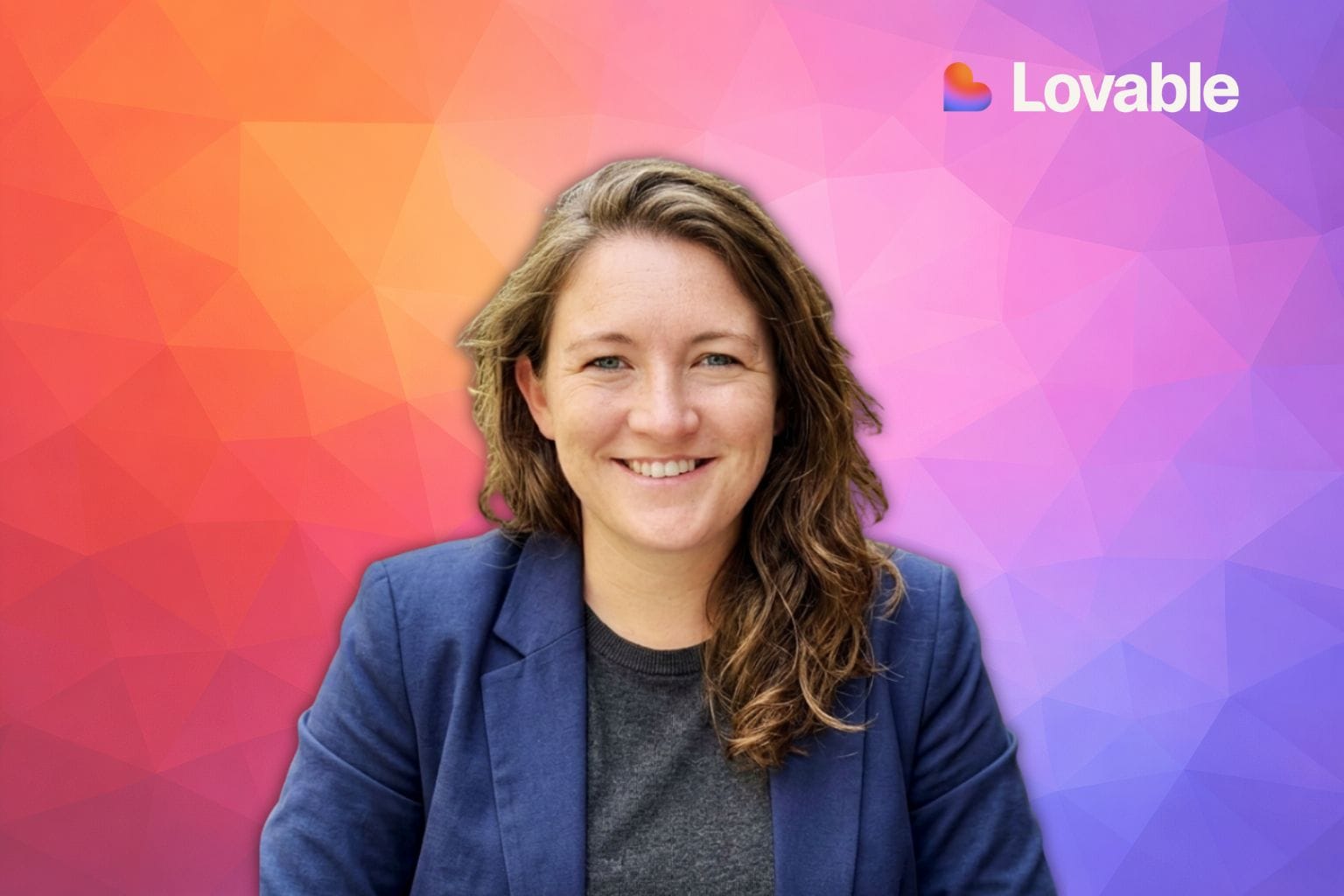

Lovable’s Whitney Menarcheck on AI Opportunity, Community-First Thinking, and More
Whitney Menarcheck, Head of Community at Lovable, spoke with NervNow about the thread connecting grief counseling to AI community building, the SheBuilds movement, what real community looks like at a fast-growing AI company, and why this moment in tech may be the closest thing to a level playing field women have ever seen.
Interview
›
Community and AI
›
Women in Tech
NervNow Interview Series
Building Has Always Been Possible for Everyone. Now There Is Finally a Tool to Match.
Whitney Menarcheck, Community Manager, Discord and SheBuilds, Lovable, spoke with NervNow about the thread connecting grief counseling to AI community building, the SheBuilds movement, what real community looks like at a fast-growing AI company, and why this moment in tech may be the closest thing to a level playing field women have ever seen.
W
Whitney Menarcheck
Community Manager, Discord and SheBuilds, Lovable · Entrepreneur · Community Builder
Whitney Menarcheck has spent her entire career dismantling the barriers that keep people from building the lives they want. A licensed counselor turned addiction medicine editor, startup founder, and now managing Discord and SheBuilds at one of the fastest-growing AI companies in the world, she channels that same drive into building a global community of creators at Lovable, from first-time builders to seasoned developers, united by the belief that the ability to build should belong to everyone.
About Lovable
Lovable
Lovable is a software creation platform that empowers anyone to build full-stack apps and websites by chatting with AI. In its first year, builders created over 25 million projects with Lovable. Lovable-built applications now attract nearly 300 million visits per month. Teams at companies like HCA Healthcare, HubSpot, Microsoft, Uber, and Zendesk rely on Lovable to build internal tools and prototypes, and to turn ideas into production-ready applications in hours instead of weeks. By removing technical barriers and long development cycles, Lovable enables creators to ship real products in days.
lovable.devWhitney Menarcheck does not talk about community the way most people do. She does not reach for engagement metrics or growth dashboards. She reaches for something older: the question of who gets to build, and what happens when that answer finally starts to change. NervNow sat down with her to find out how a background in behavioral health shaped her approach to AI community, what SheBuilds revealed about the ideas that do not make it to venture pitch stages, and why she believes this AI moment is the first real opening women have had in tech.
On Her Journey
NervNow
You went from licensed counsellor to addiction medicine editor to founding a tech startup to community building at one of the fastest-growing AI companies in the world. What is the thread that actually connects all of it?
Whitney Menarcheck
The thread is removing barriers. It has always been about removing barriers.
I started as a grief counselor, where the barrier was not death. It was society’s discomfort with it, which made grieving people feel like something was wrong with them. In the substance use space, the barriers are everywhere, and the work was about helping people find a way through them to the life they wanted and had the potential to build.
Lovable is built on the same premise. Only 1% of the world knows how to code, but that has never been a reflection of who has good ideas. It is a reflection of who has had access to the tools to build them. That is what Lovable changes.
Different how, same why. People getting to live the lives they have always wanted. Getting to do the things that make them feel whole. Coming to life.
NervNow
You have spent time in systems built to help people: behavioral health, public services, now tech. Has that background changed how you think about what a good tech community actually looks like?
Whitney Menarcheck
I have seen a lot of companies treat their community as a warm place to drive conversions. While I understand the thought process behind that, I do not view community in that way.
When I was working in behavioral health, my role was never to dictate or steer someone toward a particular outcome. It was to protect their ability to make their own choices and give them information, resources, and safe spaces to make those choices for themselves. The moment you enter with an outcome you are driving towards, and thus serving yourself or the organization instead of the patient, you are no longer fulfilling the purpose of your job.
A good tech community operates the same way. It exists for the people in it, because of the people in it, not the company behind it. That means not just tolerating, but actually welcoming, the friction and the complaints. The moments where someone tells you directly that our product is failing them in this specific way.
Community is not something we manage. It is something we are in. And that distinction really matters, because people can tell the difference.
I think we try to live that at Lovable, though it is something we have to keep choosing, keep prioritizing. Our Discord server is proof of which kind we are trying to be. Anyone from engineers to PMs to our CEO hangs out and engages with users. It started as the place where our cofounders and first hires connected with early users, and then it grew organically, led by community champions who did not need to be asked. You cannot manufacture that. You can only create the conditions for it.
On SheBuilds
NervNow
SheBuilds Season 1 drew nearly 3,000 applicants globally. When you look at who actually showed up, who were the women in those rooms, and what did they build?
Whitney Menarcheck
I would be doing the women who showed up a disservice if I tried to capture them all with a few descriptives. When I think back on them, I do not think about job titles or life circumstances. I think about what they carried into the space with them. They were scared, yet brave. Ambitious while vulnerable and supportive of others. More than anything, showing up was an act of self-belief. For a lot of the women, that was the hardest part, not the building. It was deciding that they were someone who could create, that they were someone who could build.
The builds reflected that same range. But one pattern stood out: a significant number of the projects were focused on social impact. Problems that do not always attract venture funding or product roadmap priority. And I do not think that was a coincidence. I think it tells us something about what happens when you expand who gets to build. The problems that get worked on expand, too.
NervNow
What is the one thing that happened during SheBuilds that you did not plan for but could not have scripted better?
Whitney Menarcheck
What I did not anticipate was that the competition stopped feeling like a competition from the very moment we first brought them all together. There was just this unspoken pact that seemed to exist before anyone had even said a word to each other. Yes, they were there to build their idea. Yes, it would be great to win. But they were also there to learn, to help others learn, to cheer for each other and hold each other up. The success of every woman in that room felt more important than any one person taking the top spot.
You cannot script that. You cannot even ask for it. It either happens or it does not. And those women chose to make it happen. I am forever grateful for that.
NervNow
SheBuilds is described as a movement, not just an event. What makes the difference between a campaign that ends on March 8 and one that actually builds something lasting?
Whitney Menarcheck
The difference is always the people. You can provide every resource imaginable, but if the purpose does not resonate, it ends when the event does.
SheBuilds is not separate from what Lovable is. It is an action taken to express what Lovable stands for. We believe building should be possible for everyone, and for too long that has not been true for a lot of women. When the purpose is that honest, the people who show up feel it. They do not show up for an event. They show up for something they actually believe in. That is what makes it last.
NervNow
Anthropic and Claude participated in the International Women’s Day event. What did that collaboration look like on the ground?
Whitney Menarcheck
This year we hosted SheBuilds on Lovable for International Women’s Day, a free Lovable build day made possible in partnership with Anthropic, who also offered $100 in free API credits. Margot van Laar, an applied AI engineer at Anthropic, joined us for a fireside chat, which grounded the day in something real. Having someone who actually builds AI systems sit down with our community was not just inspiring. It was a signal about who belongs in that conversation. Stripe also offered $250 in fee credits to participants launching their businesses.
When partners show up that way, barriers do not just get named. They start to fall.
On Community Building Inside a Fast-Moving AI Company
NervNow
Lovable is growing at a pace most companies do not survive. What does community building look like when the product itself is changing week to week?
Whitney Menarcheck
The product changes constantly. It has to. What does not change is who shows up. Anton is in our Discord. Our Head of Product is in the weeds with community members on feature requests. We are growing fast, but the distance between our community and the people making decisions has not caught up with that growth yet. And honestly, I do not think it ever will.
NervNow
In a Discord with over 150,000 members, how do you actually make people feel seen?
Whitney Menarcheck
Consistency, authenticity, and presence. But in a server with over 150,000 members, those things only scale through people who genuinely care, and that means our community champions more than anyone else.
They are the ones who notice when someone is stuck, who make a newcomer feel like they landed somewhere worth staying, and who hold the culture together daily. My job is to give them what they need to do that well. And then get out of the way.
NervNow
What is the most common mistake companies make when they try to build community around an AI product?
Whitney Menarcheck
Building it like a feature instead of a relationship. Companies make the mistake of launching a community the same way they launch a product update, with an announcement, a channel, and a plan. Then they wonder why nobody shows up twice.
Belonging cannot be scheduled. It grows when people feel genuinely seen, safe, and connected to something real. Early in my role I did something that terrified me: I opened a live event on Discord with no agenda, structure, or prepared talking points. I thought it would be an hour of complaints. It was not. We had a great conversation. Now I do it twice a week with our champions, and we keep it agenda-free every time.
Some days the conversation is rich and goes in directions I never expected. Some days there are silences and lulls. But whatever the tone, we are there. Open, present, and consistent.
On Access, Building, and the Technical Side
NervNow
Lovable enables anyone to build full-stack apps and websites by chatting with AI. The build used to be the hard part. Has that changed the questions your community is asking?
Whitney Menarcheck
Completely. Lovable has changed that. So now the questions people are sitting with are different: how do I know if this idea is a good one? How do I get paying users? How do I grow it into a business?
That is an exciting shift, and it is one Lovable is thinking about deeply as a product. In the community, my job is to make sure people have what they need to navigate all of it, not just the build.
NervNow
Is removing the technical barrier enough to act as the great equalizer, or is access to the tool only the first barrier?
Whitney Menarcheck
Removing the technical barrier is real and significant. Let us not undervalue that. It is the start of a snowball effect. Lovable opens the funnel to people who would never have been able to enter it before. More ideas become buildable. More people become builders. That matters. A lot.
But the funnel does not end at the build. Visibility, funding, distribution, finding the right users. Those are all still real challenges. The equalizer framing is true and also a bit incomplete.
What gives me genuine confidence is that Lovable’s product improvements show an awareness of this. Features like our general tasks capabilities show that we are thinking about more of the journey, not just the entry point. We are working on how far through the funnel people can actually get, and that feels like the right problem to be solving.
On Women in AI
NervNow
From where you stand, not the press release version, what is the actual state of women’s participation in AI right now?
Whitney Menarcheck
Honestly, the participation gap is still there. Women are not adopting AI at the same rate, and that is a problem worth naming directly. But here is what makes this moment different from every previous tech shift: nobody has a twenty-year head start this time.
There is no one with a tenured career in prompt engineering or vibe coding. That changes the math on what it means to catch up, or even how much catching up has to happen. For women, and honestly for everyone who has historically been left out of the rooms where technology gets shaped, this is the closest thing to a level playing field we have seen.
The opportunity is real. The question is whether enough people recognize it in time to use it to their advantage.
NervNow
What would you tell a woman who is curious about building with AI but does not know where to start and does not have a technical background?
Whitney Menarcheck
Tell someone you are curious. Not to ask for permission, just to say it out loud. You would be surprised how many people are in the exact same place, or how quickly someone offers to figure it out with you.
Find a community. Our Discord and local Lovable events exist exactly for this. Not just to answer questions about AI but to make you feel like you belong in the conversation.
And be honest with yourself about failure. Women are often the last to give themselves room to try something and not nail it immediately. That is the wrong standard for learning anything new, especially this. Try, stumble, try again. That is not failure. That is how it works.
The Closing
NervNow
You teach entrepreneurship by asking students to start with why. What is your why, the one that has stayed consistent across every version of your career?
Whitney Menarcheck
About six years ago I sat down and actually wrote it out. Not a job description or a career goal, but my why for everything. It has stayed true ever since: to eliminate barriers and cultivate opportunities for others to achieve their self-defined success, meaning, and fulfillment.
When I found Lovable, the fit was immediate. Every version of my career has been a different how wrapped around the same why. Lovable just happens to be the most powerful how I have ever had access to.
NervNow
What does responsible AI look like to you, not as policy, but as something you actively think about in your role?
Whitney Menarcheck
Responsible AI starts with resisting the urge to treat AI as categorically different from every other disruptive thing humans have introduced into the world, because it is not. Medications, policies, technologies, products. They all arrive with the same fundamental questions attached: Who is affected? How are they affected? Are the benefits real and do they outweigh the risks? Are we thinking about the people least likely to be in the room where decisions get made?
The answers change depending on what you are building. But the questions do not.
Does the person in front of me have what they need to make their own informed decision? That thread runs from behavioral health all the way through to how I think about our community at Lovable.
Do Not Miss These Interviews
- Europe Lost AI, Quantum is Next Unless We Act Now: Aneli Capital’s Daiva Rakauskaitė
- Women Must Understand How AI is Sold, Procured, and Regulated: Chaitra Vedullapalli, Women In Cloud
- India’s AI Problem is Product Thinking: Hoonartek’s CEO Peeyoosh Pandey
- AI Governance Must Match AI Authority: FSS’s Rishi Verma on Fraud, Reconciliation, and the Next Phase of Intelligent Payments
- Without System Maturity, AI Remains Just a Tool: Hector’s Meher Patel on What Brands Keep Getting Wrong