© 2026 NervNow™. All rights reserved.

 ByNN Desk
Jubilant Bhartia Foundation, McGill University to Open AI Center in India
The partnership, signed in Mumbai on Friday in the presence of ministers from both India and Canada, will establish a Center of Excellence in AI Education and Research aimed at closing the country's deepening AI talent gap.
The partnership, signed in Mumbai on Friday in the presence of ministers from both India and Canada, will establish a Center of Excellence in AI Education and Research aimed at closing the country’s deepening AI talent gap.
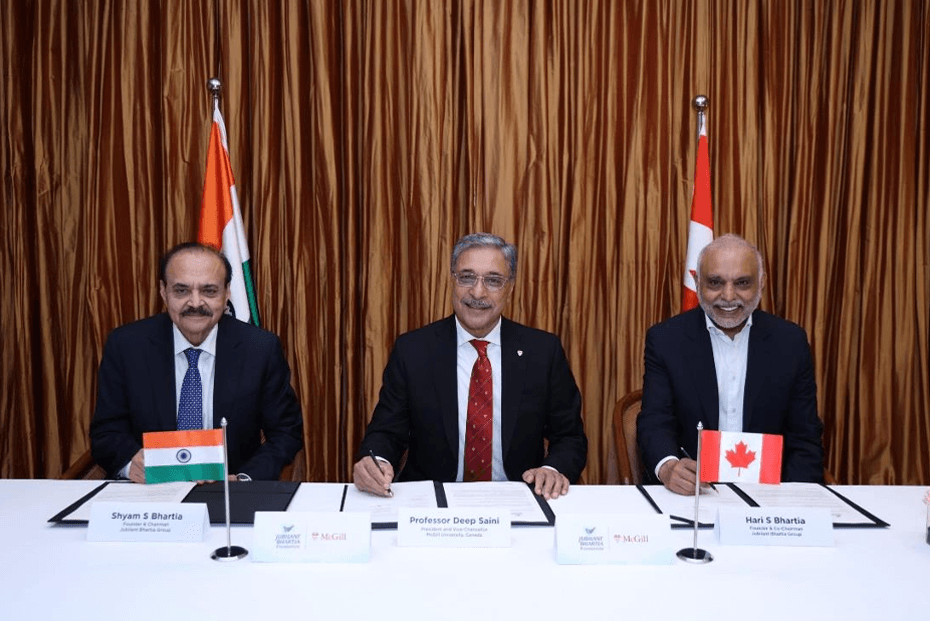
The Jubilant Bhartia Foundation and McGill University signed a Memorandum of Understanding on Friday to establish a Center of Excellence in AI Education and Research, a joint initiative designed to produce industry-ready AI engineers and applied research talent for India’s growing technology sector. The MOU was signed on the sidelines of an event attended by Canada’s Minister of Foreign Affairs, Anita Anand, and India’s Union Minister of State (Independent Charge) for Skill Development and Entrepreneurship and Minister of State for Education, Jayant Chaudhary.
The agreement was formalized by Shyam S. Bhartia, Founder and Chairman of the Jubilant Bhartia Group, Hari S. Bhartia, Founder and Co-Chairman, and Professor Deep Saini, President and Vice-Chancellor of McGill University. The signing marks one of the more substantive India-Canada academic partnerships in the AI space, bringing together a Montreal-based university with a significant research track record and one of India’s established industrial conglomerates with a philanthropic foundation focused on education and skills.
The Center will initially offer a Master’s programme combining academic rigor with applied learning. Students will work on projects tied to real technological challenges in the Indian AI sector, with curriculum designed to adapt alongside the industry rather than lag behind it. The programme is intended to produce graduates capable of moving directly into enterprise-scale AI deployment, a profile that Indian industry has consistently said is in short supply.
ALSO READ: Have You Enrolled in This Free AI Course Yet?
Shyam and Hari Bhartia said in a joint statement that India’s need for industry-ready AI talent has never been greater and that the partnership with McGill University is designed to create an ecosystem where academic rigour meets real-world execution. They described the Center’s goal as supporting India’s ambition to become a global AI powerhouse.
“The Center of Excellence in AI Education and Research in India represents an important step in expanding the University’s global presence, strengthening international partnerships, and extending its academic reach.”
Professor Deep Saini, President & Vice-Chancellor, McGill University
What the Center will do
Beyond the Master’s programme, the Center is positioned as a research hub for AI solutions tailored to India’s digital transformation priorities. McGill University will oversee curriculum design, academic standards, and quality assurance, while also building out research partnerships with Indian industry. The programme will draw on international faculty alongside industry experts for mentorship and continuous assessment.
The curriculum framework emphasizes five areas: strong theoretical foundations in AI, agility to adapt content as the field evolves, applied learning through live projects and industry case studies, global best practices in AI research, and ongoing mentorship from both academic and industry practitioners. The model is a deliberate departure from traditional degree pathways, which organizers said have struggled to keep pace with how quickly the technology is changing.
Professor Saini said the Center represents an important step in McGill’s global expansion and thanked both governments for acknowledging the initiative. He said the next phase will focus on curriculum design, academic standards, and deepening research partnerships with Indian industry.
The talent gap it is addressing
India’s digital economy has been growing rapidly, with AI adoption accelerating across sectors including financial services, healthcare, logistics, and manufacturing. The country produces a large volume of engineering graduates annually, but industry has consistently flagged a mismatch between graduate profiles and what AI deployment at scale actually requires. The demand is for engineers with deep expertise in AI systems, not just familiarity with tools, and for researchers who can bridge the gap between academic output and applied product development.
The Center’s founders said this gap is the specific problem they are trying to solve. The partnership leverages McGill’s research-led AI ecosystem to build a program that is anchored in academic credibility while remaining connected to what Indian enterprises and global AI companies operating in India actually need from the talent they hire.
IN CASE YOU MISSED: Google Launches AI Professional Certificate on Coursera
The timing of the announcement, on the sidelines of a high-level India-Canada diplomatic engagement, shows the political backing behind the initiative. Both governments have been working to strengthen technology and education ties, and the Center positions itself as a concrete output of that relationship.
McGill’s involvement gives the programme immediate international credibility. Founded in Montreal in 1821, it is Canada’s top-ranked medical doctoral university and draws students from nearly 150 countries across 700 programmes of study. More than a quarter of its 40,000-strong student body is international, a profile that suggests the Center’s curriculum will be built with global mobility in mind, not just domestic placement.
The Jubilant Bhartia Foundation is the philanthropic and CSR arm of the Jubilant Bhartia Group, a multi-billion dollar conglomerate with operations across pharmaceuticals, chemicals, food service, and auto retail, employing around 56,000 people across more than 80 countries. The Group has four listed companies on Indian exchanges. Its foundation work has focused on primary education, healthcare, and skills development, making the AI Center a natural extension of an existing mandate rather than a departure from it.
Details on intake numbers, fees, admission timelines, and partner institutions for the applied learning component have not yet been disclosed. The next phase, according to Professor Saini, will focus on curriculum design and quality assurance before the programme opens for applications.
Disclaimer: This article is based on the official press release issued by the Jubilant Bhartia Foundation on February 28, 2026. All quotes are sourced directly from the press release. NervNow has not independently verified additional details beyond what was disclosed in the announcement.
MORE ON INDIA & AI
After the Applause: What Did the India AI Impact Summit Actually Deliver?
With Sarvam and Krutrim, Has ‘Make in India’ in AI Finally Arrived?
$210 Billion AI Push: How Reliance and Adani Shaping India’s Future
Google Pledges $15 Billion to Build India’s First Full-Stack AI Hub
India Unveils 12 Indigenous AI Models Under IndiaAI Mission