© 2026 NervNow™. All rights reserved.


AI in Retail: What Reliance, Tata are Building that Other Retailers are Not
Country’s two conglomerates are building infrastructure on top of data they have been collecting for decades. Here is exactly what they are doing, what the verified numbers confirm, and what it means for every retail leader operating in India in the age of AI.
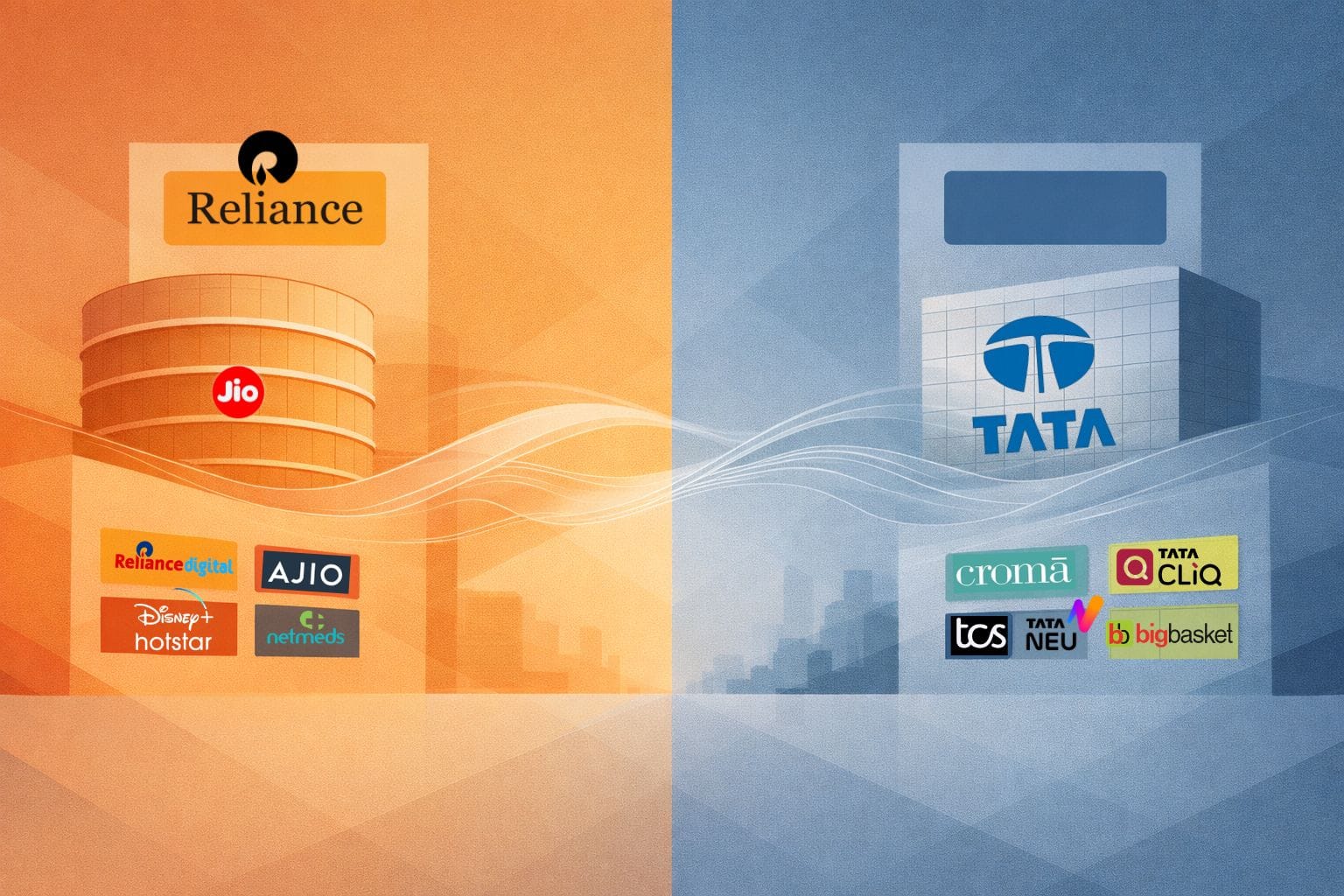
Reliance has 349 million registered customers transacting across grocery, electronics, fashion, pharmacy, and financial services, and it is feeding all of that into AI infrastructure built at a scale that most Indian retailers cannot possibly benchmark against. Tata, operating through a super-app that connects BigBasket, Croma, 1mg, Air India, and Taj hotels under a single loyalty layer, is building the same structural advantage from a different direction.
Neither company is running pilots or exploring possibilities. However, both are constructing data infrastructure that grows more valuable with every transaction processed, and the compounding effect of that accumulation is already visible in their operational numbers.
The asset at the center of both strategies is not a technology platform or a vendor partnership; it is data, accumulated through physical-world consumer relationships at a scale that takes a generation to build. Understanding what Reliance and Tata are actually constructing with that data, why the advantages they are creating are structural rather than technological, and what it means for every retail leadership team that will face these players across a category, a customer segment, or a geography in the next three years, is more strategically valuable than any general commentary about AI’s potential.
The real moat is not AI, but the data the AI runs on. And both companies have been building it for longer than most of their competitors have existed.
What Reliance is actually building
Reliance Retail’s operational scale as of December 2025 is registered customer base stands at over 378 million people, which represents more than one-third of India’s population. It processed 1.4 billion transactions in fiscal year 2025 alone, a figure Isha Ambani shared at the company’s August 2025 AGM approaches India’s total population. Its store network covers 19,979 locations across 78.1 million square feet of retail space, a footprint that no other Indian retailer comes close to matching. These are statistics about the depth and breadth of a consumer dataset that AI models are now running on.
378 million+
Registered customers as of Dec 2025
1.4 billion
Transactions processed in FY2025
19,979 stores
Across 78.1 million sq ft
The architecture that makes this dataset so powerful is Reliance’s vertical integration across every major consumer touchpoint. Jio, with 506 million subscribers as of December 2025, generates behavioral data on what its customers browse, search, and engage with online. Reliance Retail generates transaction data across grocery, electronics, fashion, and pharmacy. AJIO and JioMart contribute e-commerce signals. Jio Financial Services adds payment and credit behavior. JioHotstar, formed after the Reliance and Disney merger completed in February 2025 with a combined base of over 500 million users, brings content consumption patterns into the picture. No other retailer in India has a simultaneous view of the same consumer across all of these dimensions. A competitor with excellent data in one category is, by definition, working with a fraction of the behavioral picture that Reliance has.
To understand why this matters, let’s consider a single customer. She buys baby formula at a Reliance Smart store in March. She streams children’s content on JioHotstar the same week. She orders paracetamol on JioMart the following weekend. From these three signals, a well-built AI model can infer she has a newborn, the baby has a fever, and she has not slept properly in weeks. AJIO, Reliance’s fashion platform, now knows to show her comfortable feeding-friendly clothing and not the occasion wear she bought before the baby arrived. A standalone fashion retailer, seeing only her past fashion purchases, would still be recommending the occasion wear. It does not know about the baby. It cannot know. It only has one category of data.
That is what cross-category data actually means in retail. It is not an abstract technological advantage. It is the difference between knowing what a customer bought from you and knowing what is happening in their life right now.
At the August 2025 AGM, Mukesh Ambani announced the infrastructure being built to convert this data into AI capability at scale. The first piece is a dedicated AI cloud region in Jamnagar, built and powered by Reliance’s own green energy infrastructure, connected through Jio’s fiber network, running Google Cloud’s AI hypercomputer stack. The second is a joint venture with Meta, incorporated as Reliance Enterprise Intelligence Limited, funded with an initial INR 855 crore investment (approximately $100 million), with Reliance holding 70 percent and Meta 30 percent. The venture will build enterprise AI products on Meta’s open-source Llama models for Indian businesses. Together these represent Reliance building the compute and the AI layer it needs to make its data work at the scale it operates.
To be precise about what is confirmed and what is not: the data architecture described above is real and verified. Whether Reliance has fully activated cross-category personalisation in production, at the consumer-facing level, is not publicly confirmed. What is confirmed is that no other retailer in India has assembled the infrastructure that would make it possible. The competitive significance is not that it is definitely happening today. It is that Reliance is the only company in India positioned to do it at all, and they are building the compute infrastructure to do it at scale.
THE QUESTION FOR YOUR BOARD: If Reliance activates cross-category personalization at scale, converting even one percentage point more of its 378 million registered customers to higher-margin categories, the revenue impact exceeds what most Indian retailers generate in total. What is your answer to that?
Tata’s turn
Tata’s approach is different from Reliance’s, and the difference is worth noting because it creates a different competitive conundrum for the rest. Reliance is building a data moat by accumulating consumer knowledge across its own vast network. Tata is using TCS to build AI retail tools, testing and refining them on its own stores first, and then selling them commercially to the rest of the market. The consequence of this is that Tata’s own retailers will always be running the newest version of these tools, with the most operational experience behind them, while any external buyer will always be running a version of what Tata’s stores ran one to two years earlier.
The clearest example is what TCS delivered for Croma. On August 12, 2024, TCS deployed its OmniStore platform across all 500-plus Croma stores in more than 160 cities, completing the nationwide rollout in two weeks. Before OmniStore, Croma stores ran on traditional billing hardware: physical counters, dedicated terminals, staff tied to fixed positions. After OmniStore, every staff member with a mobile device could process a transaction anywhere on the floor. Billing hardware was eliminated entirely. About 83 percent of the space that used to house bill desks became selling floor. Billing setup became four times faster. Customers could pay through more than 80 options including UPI, cards, wallets, and loans embedded at point of sale. Shibashish Roy, Deputy CEO of Croma, described their goal as becoming number one in customer experience in India, and said the OmniStore partnership was the foundation of that ambition.
83%
of Croma bill desk space freed for selling floor (2024)
4x
faster billing setup, 500+ stores, nationwide in two weeks
80+
payment options including UPI, cards, wallets, loans
OmniStore is part of TCS’s Algo Retail suite, which also includes Optumera, an AI platform that helps retailers make decisions about pricing, which products to stock, and how much inventory to hold. TCS works with the world’s ten largest retailers globally. The point of the Croma deployment is that Tata is running this capability on its own stores first, paying for the learning curve internally, before selling it to the market. A competitor that licenses OmniStore today gets a platform that has been tested across 500 stores through multiple Diwali seasons. They do not get the two years of operational learning that Croma has already accumulated. That gap does not close.
The second part of Tata’s strategy is Tata Neu. The app sits above every Tata consumer business: BigBasket for grocery, 1mg for pharmacy, Curefit for fitness, Croma for electronics, TataCLiQ for fashion, Air India for travel, and Taj for hospitality. The NeuCoins loyalty currency is what connects them. When you earn coins buying groceries on BigBasket, Tata has a reason to show you an Air India offer, a Croma deal, and a Taj weekend package. Each transaction in one category tells Tata something about you that it uses across all the others.
A customer who orders fever medicine on 1mg and comfort food on BigBasket in the same 48-hour window is probably unwell. Tata Neu’s AI, if well-built, should be showing that customer Curefit recovery content and not a promotion for a fitness challenge. A customer who has booked Air India flights to a foreign destination three times in two years and orders premium whisky on BigBasket is probably the customer Taj hotels should be targeting for their international properties. A standalone grocery app cannot make that connection. Tata Neu, in principle, can.
TataCLiQ has also deployed CliQ Genie, an AI shopping assistant built with Haptik, that recommends products, reads user reviews to surface what customers actually care about in a given product category, and guides high-value purchase decisions before handing off to a human when the transaction needs it. It is live on the TataCLiQ website and Android app. Every conversation it handles teaches it more about how Indian premium retail consumers think and shop, which is a data asset that compounds over time.
THE QUESTION FOR YOUR BOARD: TCS will sell OmniStore to any retailer that wants it. Your competitors can eventually buy what Tata built. What they cannot buy is two years of Diwali traffic, real operational learning, and the AI models that Croma’s 500 stores have been training since 2024.
Three structural advantages
The first is the data moat. Reliance has 1.4 billion transactions a year flowing through its systems. Every transaction is a data point, and every data point makes the next AI model slightly better. This gap does not require Reliance to make any strategic decision to maintain it. It grows automatically because Reliance keeps selling groceries, and every grocery sale is another piece of data. A retailer that starts building its customer dataset today will be years behind on volume and decades behind on the variety of signals Reliance holds across categories, geographies, and income groups.
The second is the infrastructure advantage Tata has built through TCS. The value here is more than the technology, which is available to buy. It’s the operational knowledge that comes from running it through a full retail calendar on 500 stores. One cannot buy that knowledge and has to have a first-mover advantage to accumulate it.
The third is what both companies can do that a focused retailer simply cannot, regardless of budget: they can see the same customer across different moments of their life. Reliance knows when the same person buys school supplies, a smartphone, and a new outfit in the same month. That combination suggests a child starting a new academic year, which is a life event with a predictable set of needs that a clever AI can anticipate. A retailer that sells only smartphones sees a smartphone purchase. It does not see the school supplies or the outfit, and it cannot make the inference. No amount of technology investment changes this. The only fix is having more kinds of customer data, which requires building more kinds of consumer businesses, which is not a realistic path for most retailers.
Where a focused competitor can still win
The answer to all of the above is not to try to replicate what Reliance and Tata have built. That would require decades, a telecom network, and an entertainment platform. The answer is to identify where a focused retailer has a natural advantage that size and breadth cannot override, and to use AI to deepen that advantage rather than deploying it in a competition that was already decided before it began.
Conglomerates, by necessity, build wide consumer knowledge rather than deep category knowledge. A retailer that sells nothing but premium apparel can build AI models that understand the Indian fashion consumer at a level of granularity that AJIO, for all its data, does not prioritize. AJIO needs to be decent at fashion and decent at everything else. A specialist needs to be excellent at fashion and nothing more. A specialty pharmacy can build recommendation models that understand drug interactions, chronic condition management, and prescription refill patterns at a depth that Netmeds probably, running across ten categories, does not focus on right now. A high-end electronics retailer can build post-purchase service intelligence, knowing exactly when a customer’s television is likely to need a repair and reaching out before they call a competitor, that Croma, managing 20,000 store employees across every product category, perhaps not prioritized yet.
Deploying AI is not a question anymore. That decision has been made for you by the market. The proper question is where specifically to deploy it, so that your focus becomes a competitive advantage rather than a structural limitation.
Three decisions that cannot wait
The first is to get your customer data into one place. Most Indian retailers hold transaction records in one system, loyalty data in another, e-commerce behavior in a third, and in-store data in a fourth, with no single record that connects all four to the same human being. An AI model fed this fragmented picture will produce recommendations that are capped by how incomplete the picture is. Before any AI investment makes sense, the underlying question is whether you actually know who your customer is across all of their touchpoints with your business. Most retailers, if honest, do not.
The second is to decide explicitly whether you are competing on breadth or depth. Competing across categories against Reliance or Tata means competing exactly where their advantage is greatest. Competing with depth in a specific category means competing where their attention is spread thin. This is a strategic choice that determines where AI investment produces real returns. Most retail leadership teams have not made it explicitly. The window to make it deliberately, rather than having it made by default, is closing.
The third is to take an infrastructure position before the market stratifies. TCS OmniStore is available today. So are AI retail platforms from Infosys, Wipro, and a growing range of specialist vendors. Whether to build proprietary AI infrastructure or deploy what the market offers is a decision with a three to four-year horizon on its consequences. Companies that defer it are not holding a neutral position while they think. Every quarter they wait, Croma is another quarter ahead on operational learning, and their own customers are another quarter closer to the seamless experience that raises their expectations of every other retailer they walk into.
Disclaimer: This article has been researched and produced by the NervNow expert editorial and research team. All data points, figures, and strategic assessments reflect information available at the time of publication. This brief is intended for informational purposes only and does not constitute financial, investment, or strategic advice.
MORE ON TCS & RELIANCE
TCS, Zscaler New AI Workspace Tool
OpenAI Partners with Tata; Anthropic Opens Bengaluru Office at AI Summit
AI Risk Jobs: Barclays, Accenture, TCS, and More
Reliance Commits $110 Billion to Build India’s Sovereign AI Infrastructure
$210 Billion AI Push: How Reliance and Adani Shaping India’s Future
Article Sources: Reliance Industries Integrated Annual Report FY2024-25 (ril.com); Reliance Retail Key Facts page (relianceretail.com/key-facts.html, accessed February 2026); Isha Ambani remarks at Reliance 48th AGM, August 29 2025; TCS OmniStore press release, August 12 2024 (tcs.com); TCS OmniStore Croma case study (tcs.com); Google Cloud Jamnagar media release, August 29 2025 (ril.com); Reliance-Meta REIL joint venture filings, October 24-25 2025 (Business Standard, Inc42, IBEF); REIL share allotment, February 25 2026 (Business Standard); TRAI Telecom Subscription Data, September 2025; JioHotstar merger announcement, February 2025; Haptik TataCLiQ CliQ Genie case study (haptik.ai).