© 2026 NervNow™. All rights reserved.

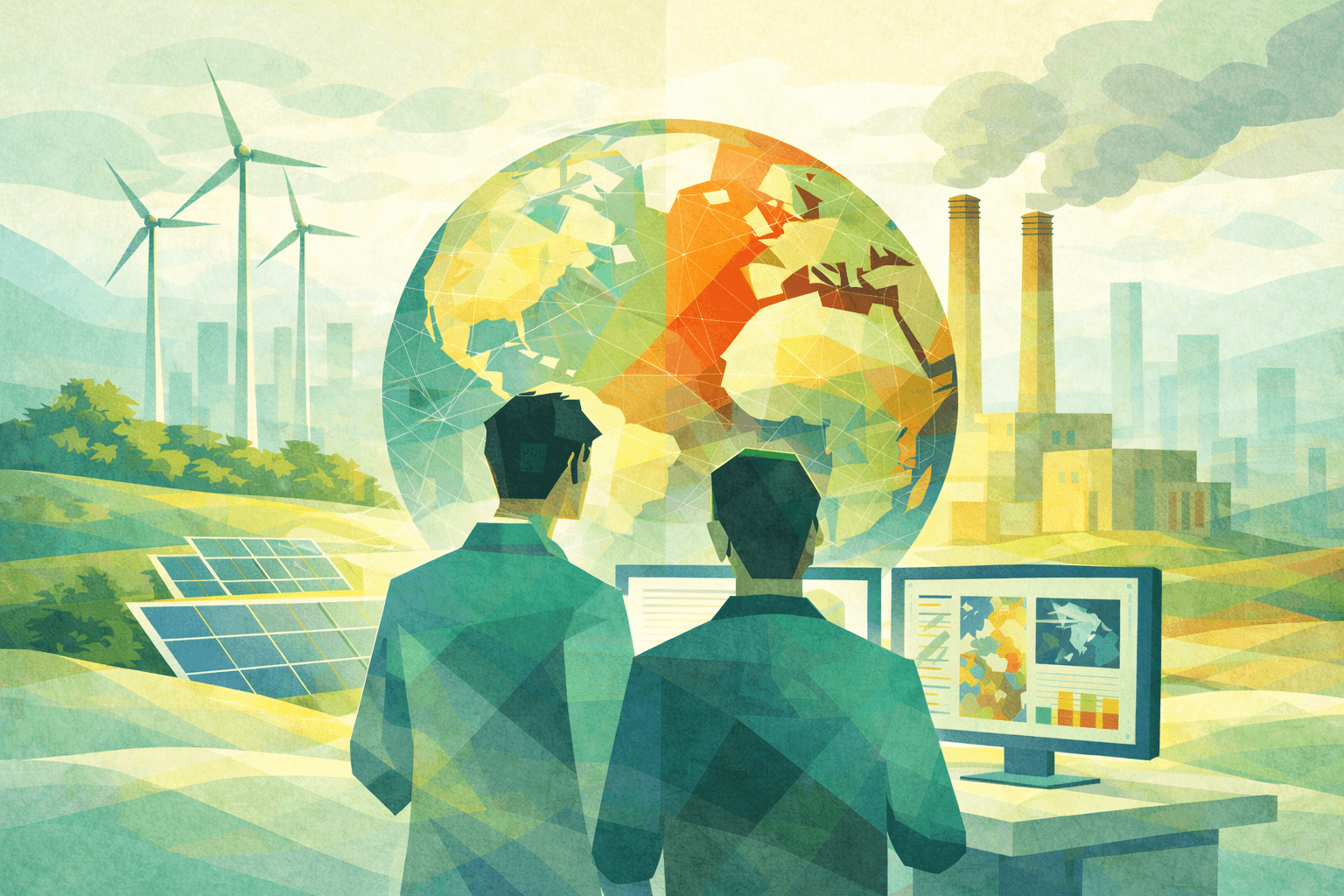

The Price of Inaction: How AI is Turning Climate Risk Into a Capital Decision
Rajashri Sai, founder and CEO of Impactree.ai, argues that climate risk has crossed a threshold, from compliance narrative to capital variable, and that artificial intelligence is the decision infrastructure that makes the difference.
Analysis/Climate Risk & AI
From Disclosure to Decision: How AI Is Changing the Way Enterprises and Investors Understand Climate and ESG Risk
Rajashri Sai, founder and CEO of Impactree.ai, argues that climate risk has crossed a threshold, from compliance narrative to capital variable, and that artificial intelligence is the decision infrastructure that makes the difference.
Read Time · 9 mins
For a long time, climate and ESG lived in the safe zone of disclosure. Companies reported exposures, published sustainability reports, and responded to questionnaires, but the underlying assumption remained unchanged: climate risk was important, but not yet decisive. It informed narratives more than it made capital differences. It was compliance.
That assumption is now breaking down.
The Context Has Fundamentally Shifted
The last few years have altered the context in which climate risk is understood. According to the World Meteorological Organization, recent years have ranked among the hottest ever recorded, with 2024-2025 marking unprecedented temperature anomalies across multiple regions. Just days ago, the United Nations weather agency confirmed that the decade between 2015 and 2025 was the hottest eleven-year period on record, and that the atmosphere is trapping greenhouse gases at a rate exceeding any prior measurement.
What people often fail to recognise is that rising temperatures, weather unpredictability, and supply chain disruption do not affect only the environment. They affect industries. Agriculture, logistics, energy, manufacturing, each is exposed in ways that can have lasting consequences for food security and economic stability.
“Transition is slower than anticipated toward mitigation, while physical risk is accelerating faster than priced. What this does, fundamentally, is collapse time.”
Rajashri Sai, Founder & CEO, Impactree.aiClimate risk is no longer a distant, modelled abstraction sitting in 2030 or 2050 scenarios. It is showing up in underwriting losses, supply chain disruptions, infrastructure stress, and increasingly, in the cost and availability of capital. And when time collapses, decision systems must evolve.
From Lagging Indicator to Leading Intelligence
Historically, ESG intelligence was constructed from static and lagging inputs: annual disclosures, ratings, and fragmented datasets that provided a partial and often outdated view of risk. Artificial intelligence is changing that fundamentally, moving climate data from a lagging indicator to a live intelligence input.
By integrating satellite data, hyperlocal weather feeds, ground sensors, logistics flows, regulatory inputs, and unstructured local-language information, AI systems can construct a continuously updating map of risk. More importantly, they simulate consequence. They can estimate how a flood event translates into asset downtime, how heat stress affects labour productivity, how drought alters supply availability, and how all of this flows into financial performance.
What AI-Driven Climate Intelligence Actually Does
Traditional ESG tools tell organizations what has happened: annual reports, backward-looking ratings, periodic disclosures. AI-powered systems tell organizations what is happening and what is likely to happen next, with real-time physical risk exposure, financial consequence modelling, and scenario simulation across supply chains, assets, and workforce.
The shift is from carbon accounting, a concept most decision-makers struggled to operationalise, to numbers that are directly attributable to revenue, cost, and capital allocation.
In doing so, AI transforms climate from a reporting dimension into a decision variable embedded within capital allocation, procurement, and strategy. It takes risk out of the realm of abstraction and into the ledger.
The Insurance Sector Has Already Moved
The market is beginning to reflect this shift, and nowhere is it more visible than in insurance, a sector that has spent years investing in climate risk modelling to protect its own balance sheet. Despite the United States being among the most prominent opponents of mandatory ESG regulation, its insurance industry has categorised climate risk as a real and quantifiable financial exposure.
Firms such as State Farm and Allstate have publicly withdrawn or restricted coverage in high-risk geographies, particularly regions exposed to recurrent wildfires and extreme weather events. The downstream consequence is a higher cost of capital for businesses and property owners in those areas. This is the real shift: from awareness to enforced risk mitigation, mediated not by regulation, but by pricing.
Where Climate Risk Is Already Reshaping Capital — Key Sectors
| Sector | Mechanism | Indicator |
|---|---|---|
| Insurance | Withdrawal from high-risk geographies; repricing of coverage | State Farm, Allstate restrict wildfire and flood exposure in the US |
| Real Estate | Rising cost of capital in climate-exposed markets | Uninsurability translating into stranded assets and depressed valuations |
| Agriculture | Supply chain disruption, yield volatility, water stress | Cascading effects on food security and commodity pricing |
| Infrastructure & Energy | Asset downtime from extreme weather; stranded fossil investments | Transition speed mismatch between policy and physical exposure |
What Investors Are Actually Demanding Now
Investors are recalibrating what they expect from ESG intelligence. The demand is no longer for better scores or more comprehensive disclosures. Most ESG regulations came into being after major industrial and financial disasters, and embedded within those frameworks is a significant body of non-financial metrics that, when properly modelled, serve as powerful predictors of financial risk.
At Impactree.ai, over three years of research and development have gone into identifying the metrics across industries that most directly drive financial risk exposure. AI tools are now enabling us to quantify those metrics against both financial and non-financial disclosures, across listed and unlisted entities, at a speed that was previously impossible. AI is exceptionally good at taking a defined process and amplifying it at scale.
NervNow Editorial Note
The distinction the author draws, between AI as a reporting upgrade versus AI as a decision system, is the central tension in enterprise ESG technology today. Most enterprise tools in this category are still being sold as compliance efficiency tools. The organizations building genuine decision infrastructure, with real-time physical risk inputs and consequence simulation, are operating in a substantially different category. That gap is where competitive differentiation will emerge over the next two to three years.
The Next Wave: Beyond ESG Disclosures
The intelligence being built in this space still requires significant development to enable AI tools to understand the context of the data they ingest. That is where the next generation of startups can make a meaningful difference, taking inputs from multiple sources, using sustainability frameworks to identify crucial drivers, and predicting outcomes and mitigation requirements.
This requires thinking about sustainability beyond ESG disclosures and beyond a single environmental lens. Sustainability operates at a resilience layer: it makes enterprises stronger for tomorrow by addressing environment, social, and governance dimensions together. The social and governance pillars are often underweighted in current systems, yet they are equally crucial drivers of intelligence and risk.
E
Environmental
Physical risk modelling, transition exposure, supply chain climate stress, water and land dependency. The most developed dimension in current AI-driven ESG tools, but still maturing in consequence simulation and hyperlocal granularity.
S
Social
Labour market exposure, community dependency, health and safety risk, supply chain human rights. Significantly underweighted in current models despite strong correlation with operational and reputational financial risk.
G
Governance
Board accountability, transparency quality, anti-corruption exposure, executive incentive alignment. Often treated as a compliance checkbox; increasingly material to capital market access and regulatory standing.
Artificial intelligence sits at the intersection of all three. It compresses detection timelines, increases analytical precision, and translates complexity into decision-ready scenarios. For markets like Southeast Asia, where the next generation is preparing to take over family-led enterprises, this data is critical for shaping internal investment strategy over time.
The Tension That Cannot Be Ignored
The infrastructure required to power advanced AI, particularly large-scale modelling and real-time analytics, is energy intensive. Data centres, which form the backbone of AI systems, are themselves significant consumers of electricity. According to estimates referenced by the International Energy Agency, data centre energy demand is projected to rise materially over the coming decade, driven in part by AI workloads. Beyond energy, the water requirements of large-scale data centres are becoming a material constraint in water-stressed regions.
This creates a tension that cannot be ignored. The same systems that enable us to better understand and manage climate risk may also contribute to the very emissions we are trying to reduce. This does not invalidate the use of AI, but it does impose a discipline. It forces organizations to move from indiscriminate deployment to prioritised intelligence, to ask not just what can be modelled, but what should be modelled.
A Practical Response: Small Language Models and Efficient Architecture
Many organizations are moving toward small language models, selecting only the indicators most critical to their specific risk profile rather than running generalised large-scale inference. Focusing on dollar value per line of compute allows developers to divide work between statistical and logical model development outside the AI system, then use AI tools to amplify and test scenarios.
This architecture significantly reduces energy load and forces the kind of intellectual prioritisation that produces better models. It is also a more defensible position as regulatory scrutiny of AI’s own environmental footprint increases.
From Hindsight to Foresight
For decades, resilience was treated as a cost, something that reduced downside but did not necessarily create upside. In a climate-constrained world, that framing is reversing. Resilience, when informed by intelligence, becomes a source of advantage. It allows firms to allocate capital more efficiently, avoid stranded assets, anticipate disruptions, and identify emerging opportunities ahead of the market.
Artificial intelligence is accelerating this shift by making climate intelligence usable at the point of decision. But the outcome is not predetermined. Organizations that treat AI as a reporting upgrade will continue to operate reactively. Those that treat it as a decision system will begin to see returns within two years of investment. The movement from disclosure to decision is, ultimately, a movement from hindsight to foresight.
And in a world where climate risk is no longer waiting its turn, foresight is not optional. It is the only viable strategy.
The views expressed in this article are those of the contributor and do not necessarily reflect the editorial position of NervNow. Information reflects the author’s analysis as of April 2026 and does not constitute financial, legal, or investment advice. Enterprises and investors should seek qualified professional counsel for jurisdiction-specific guidance.