© 2026 NervNow™. All rights reserved.


Why Europe Leads AI Regulation, Lags in AI Power
The European Union has spent years crafting the most comprehensive artificial intelligence regulation in the world. It has world-class researchers, Nobel Prize-winning institutions, and a single market of 450 million people. And yet, when you ask anyone to name the world's leading AI companies, the list reads almost exclusively American or Chinese. Something has gone wrong. The question is what.
The European Union has spent years crafting the most comprehensive artificial intelligence regulation in the world. It has world-class researchers, Nobel Prize-winning institutions, and a single market of 450 million people. And yet, when you ask anyone to name the world’s leading AI companies, the list reads almost exclusively American or Chinese. Something has gone wrong. The question is what.
The researchers who built some of the most important AI breakthroughs in recent history were European. Demis Hassabis, who founded DeepMind and won the 2024 Nobel Prize in Chemistry for AI-driven protein structure prediction, is British. Arthur Mensch, CEO of Mistral AI, is French. The three founders of Mistral all met at France’s Ecole Polytechnique before going on to work at Google DeepMind and Meta. Yann LeCun, Meta’s chief AI scientist and one of the three architects of modern deep learning, spent his formative years in France.
Europe builds the researchers. Then it watches them leave.
The continent’s universities publish more AI research papers than the United States. In 2022, European institutions produced more than 100,000 AI-related papers, outnumbering American output. That research then flows, reliably and predictably, westward. U.S. companies offer salaries two to three times higher than European counterparts, equity packages worth millions, and access to computing resources that no European institution can match. The brain drain is actually structural.
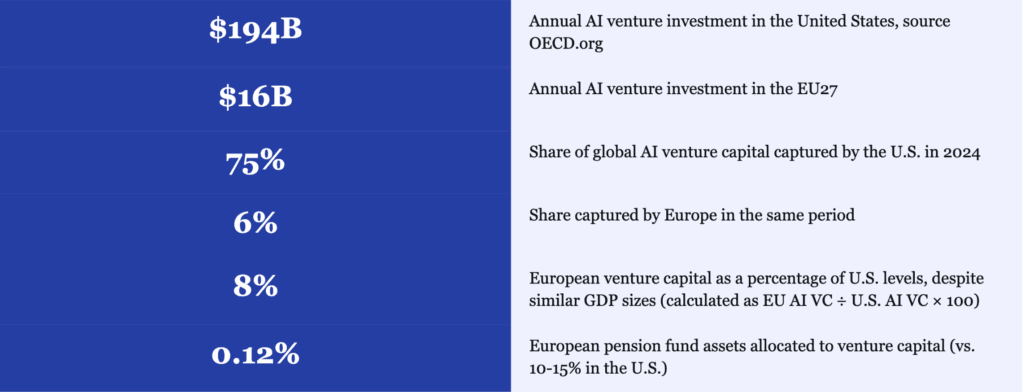
Clark Parsons, who leads the European Startup Network, puts it plainly. The problem, he says, is not talent, but finance. European AI startups raise about $8.5 million in their first funding rounds. American startups raise $13 million. U.S. venture capital firms manage roughly $270 billion, six times more than the $44 billion managed in Europe. The Bay Area alone captured more than half of all global venture investment in AI in 2024.
The gap is not just in early-stage funding; it compounds. A European startup that cannot raise enough in its seed round never builds the team that would raise a Series A. The Series A that never happens means the product that never scales. The scaling that never occurs means the global company that never forms.
Data source: OECD
The GDPR of AI, and What it Cost
In August 2024, the European Union’s Artificial Intelligence Act entered into force, making it the world’s first comprehensive legal framework for AI regulation. The law classifies AI systems by risk level, bans certain uses outright, and imposes significant compliance requirements on developers of high-risk systems and general-purpose models.
The intent was admirable: create a framework that protects citizens, establishes global standards, and positions Europe as the benchmark for responsible AI. The same logic had worked before. Europe’s General Data Protection Regulation, known as GDPR, became the de facto global standard for data privacy, with countries from Brazil to South Korea adopting similar frameworks.
The AI Act has not followed the same trajectory. Instead, it has become the subject of an increasingly heated dispute between Brussels and the European startup community.
In mid-2025, more than 30 founders and venture investors signed an open letter published by the technology news outlet Sifted, arguing that the Act risks creating what they called a fragmented and unpredictable regulatory environment that will undermine innovation, discourage investment, and ultimately leave Europe behind. A separate initiative, the EU AI Champions group, asked the European Commission to pause enforcement for two years while the sector was given time to understand the rules and build the tools to comply with them.
Also read: With Sarvam and Krutrim, Has ‘Make in India’ in AI Finally Arrived?
The specific complaint was not about regulation itself, but about implementation. The Code of Practice that was supposed to help companies understand their obligations under the Act was originally expected in May 2025. It was not published until July, just weeks before obligations came into force. Founders who must plan hiring, data acquisition, and technical infrastructure months in advance had no practical guidance during the months they needed it most.
The EU should stop patting itself on the back for being the world’s regulator in technology. We have spent far too long focusing on regulating instead of waking up every day and asking what we can do to make Europe the most competitive place on the planet. Clark Parsons, European Startup Network – Euronews
The comparison to the United States is instructive. Washington has taken what can be described as a permissive approach: allow rapid deployment, let the market determine outcomes, and course-correct when problems emerge. China couples rapid deployment with state coordination. Europe has taken a third path, one focused on establishing rights and protections before deployment rather than after. Whether that approach produces better social outcomes is a reasonable debate.
In 2024, the United States developed approximately 40 notable AI foundation models. China developed around 15. Europe produced three.
The Missing Ecosystem
Europe has no homegrown technology giants of the scale that have made American AI possible. Amazon, Google, Microsoft, and Meta collectively invested hundreds of billions in AI infrastructure, providing the cloud computing, the datasets, and the distribution networks that turned research into products. No European company plays this role.
This matters more than it might appear. A research team in Paris that builds a promising AI model needs infrastructure to train it. Without a domestic cloud provider of scale, it is dependent on Amazon Web Services, Google Cloud, or Microsoft Azure. The data pipelines, the distribution channels, the enterprise sales networks all run through American platforms. European startups, as the Bruegel think tank noted in a 2024 analysis, have to turn to U.S. companies with global business models just to amortize the fixed costs of training their models.
The result is a paradox: European companies that do succeed in AI often do so in deep partnership with American capital or American infrastructure. They remain technically European but structurally dependent.
That is the paradox Mistral AI embodies. Its founding team met at a French university. Its models are built and maintained in Paris. Its open-source approach is a direct philosophical challenge to American corporate AI. And yet its investors include Andreessen Horowitz and General Catalyst, two of Silicon Valley’s most powerful venture firms. Its models are distributed on Microsoft’s Azure platform. Although its latest funding round was led by ASML, a Dutch chip equipment manufacturer, analysts describe this move as a show of European solidarity as much as a pure investment thesis.
Can One Startup Change a Continent?
Founded in April 2023 by Arthur Mensch, Guillaume Lample, and Timothee Lacroix, all three former researchers at Google DeepMind and Meta, Mistral AI has become the most credible challenger to American AI dominance that Europe has yet produced.
In just 29 months from founding, the Paris-based company raised more than $3 billion across seven funding rounds, reaching a valuation of $14 billion in September 2025, after ASML led a $2 billion Series C. Revenue grew 25 times over the prior year, according to CEO Arthur Mensch. The company’s flagship chatbot, Le Chat, is available on iOS, Android, and the web. French telecom provider Free Mobile offers Le Chat Pro to its subscribers free of charge. French President Emmanuel Macron has publicly recommended Le Chat over ChatGPT.
Mistral’s strategic distinction is deliberate. Where OpenAI moved aggressively toward proprietary, closed systems after its initial open releases, Mistral committed to open-source models, releasing them under Apache 2.0 licenses that allow anyone to download, modify, and deploy them freely. This decision was partly philosophical and partly practical: it built developer trust rapidly, drove enterprise adoption in regulated industries where data sovereignty matters, and allowed Mistral to compete against vastly better-funded opponents without needing to match them in raw compute spending.
The company’s Mistral Medium 3, launched in May 2025, delivered what the company described as frontier-class performance at $0.40 per million input tokens, approximately 20 percent of what comparable models from larger competitors charge. Cost efficiency, not model size, became Mistral’s competitive signature.
European enterprise clients have responded. CMA CGM has committed 100 million euros over five years to deploying Mistral’s AI in financial services and logistics. Others include BNP Paribas, AXA, and Stellantis.
But the numbers keep the story honest. Mistral AI, valued at approximately $14 billion following its 2025 funding round, remains significantly smaller than OpenAI. While OpenAI was valued at around $300 billion in late-2025 private fundraising, ongoing 2026 funding discussions have reportedly pushed its valuation into the $750–850 billion range, according to multiple market reports. Mistral’s revenues remain relatively modest compared to its valuation, though exact current revenue figures have not been officially disclosed. As with many high-growth AI startups, investors are pricing in projected future expansion rather than present-day earnings.
The company has launched a compute platform, Mistral Compute, in 2025 in partnership with NVIDIA, built around high-performance GPU infrastructure. The platform is positioned as a European sovereign alternative to major U.S. and Chinese cloud providers. Whether Mistral can successfully scale and finance large-scale infrastructure expansion alongside continued model development remains an open question.
Five years from now, will Mistral be a really important European company, or will they be a really important global company? That is solved through sales and distribution. Paul Baier, CEO, GAI Insights (AI Business)
What Brussels is Now Trying to Do
The European Commission has not been static. In April 2025, it published the AI Continent Action Plan, a strategic document aimed at strengthening Europe’s competitiveness in AI through coordinated investment in infrastructure, regulatory frameworks, data, and talent. A key component of the plan is support for a network of AI Factories and AI Gigafactories, large-scale computing infrastructures connected with existing European supercomputing resources, designed to give startups, researchers, and industry access to the GPU capacity needed to develop and train advanced AI models.
The InvestAI Facility, announced alongside the Action Plan, aims to mobilize 200 billion euros in public and private investment for European AI over the coming years. Whether that number is realistic, and where exactly those billions will come from, remains a question that industry observers are watching closely.
In November 2025, the Commission also proposed targeted amendments to the AI Act as part of what it called a Digital Simplification Package (Digital Omnibus), acknowledging that the original implementation created compliance burdens that were slowing down the very innovation the law was meant to enable.
The EU AI Champions Initiative, spearheaded by the American venture capital firm General Catalyst alongside European industrial companies including Airbus, Mercedes-Benz, and Siemens, has said capital allocators stand ready to activate 150 billion euros for European AI. The involvement of American firms in leading a European industrial initiative is itself a measure of where things stand.
The Final Assessment
Europe has researchers and regulations. It also has the stated political will. What it has struggled to build is the ecosystem: the deep pools of patient capital, the domestic technology platforms at scale, and the cultural tolerance for the kind of aggressive, failure-accepting risk-taking that produced Silicon Valley.
The venture capital gap is not simply a matter of quantity. European pension funds invest 0.12 percent of their assets in venture capital. American pension funds invest 10 to 15 percent. That difference, compounded over decades, is what separates a continent of research excellence from a continent of commercial AI leadership.
Yes, the Mistral’s rise, momentum, and everything is real. European AI investment grew 55 percent in the first quarter of 2025. Twelve new AI unicorns emerged in Europe in the first half of that year. But the gap to close is enormous, and it has been widening, not narrowing, in absolute terms.
The question is ultimately not whether Europe can produce great AI companies. It can. It already has. The question is whether one great company, or even a cluster of them, can make Europe a true leader in AI by shifting structural conditions that currently keep that ambition out of reach.
That answer will not come from a regulation. It will come from a capital market, a cultural shift, and a willingness to compete rather than only to govern.
Sources: Euronews, CEPR, Bruegel Institute, TechCrunch, Wikipedia/Mistral AI, Vestbee, AI Business, Stanford HAI AI Index 2025, European Commission Digital Strategy, Sifted
The author is a cybersecurity and artificial intelligence specialist at Deloitte. The opinions expressed in this article are solely those of the author and do not reflect the views of Deloitte or its affiliates.
Do not miss:
AI vs. AI: The $40 Billion Payment War
AI Agents: The Most Overhyped Product in Tech Right Now?
Meta, Nvidia Forge Landmark Multi-Year AI Infrastructure Deal
L&T, NVIDIA Partner to Build Gigawatt-Scale Sovereign AI Factory