© 2026 NervNow™. All rights reserved.
 ByNN Desk
Ayush, BHASHINI MoU: AI to Make Traditional Medicine Accessible Nationwide
The agreement brings AI-driven speech and translation tools to India's Ministry of Ayush traditional medicine platforms across all 22 scheduled Indian languages.
The agreement brings AI-driven speech and translation tools to India’s Ministry of Ayush traditional medicine platforms across all 22 scheduled Indian languages.
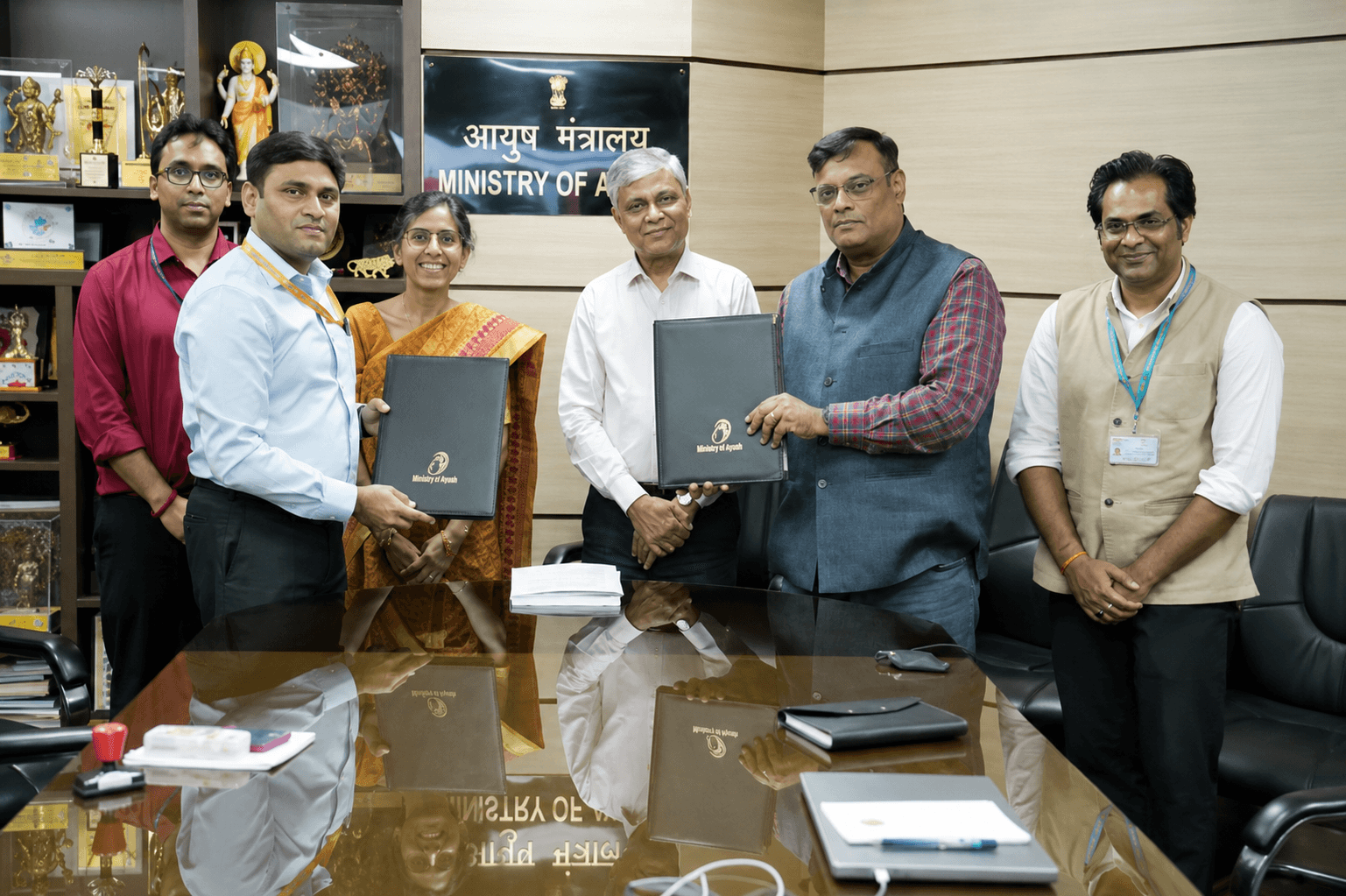
India’s Ministry of Ayush and the Digital India BHASHINI Division (DIBD), an arm of the Ministry of Electronics and Information Technology, signed a memorandum of understanding on May 14 to integrate AI-powered language technologies into the ministry’s digital platforms, the government announced via official press release.
The MoU, structured under the “BHASHINI Rajyam – A BHASHINI Sahayogi Program,” will embed BHASHINI’s translation, speech recognition, and voice interfaces into Ayush Grid portals and applications. The Ayush Grid spans healthcare delivery, drug administration, research, and capacity building across disciplines, including Ayurveda, Unani, Siddha, Yoga and Naturopathy, Sowa-Rigpa, and Homeopathy.
ALSO READ: Xpanner Bags $18M To Revolutionize Construction Sites With Physical AI
The agreement was signed by Dr. Subodh Kumar, director at the Ministry of Ayush, and Amitabh Nag, chief executive officer of DIBD. Under the deal, services on Ayush Grid platforms are proposed for deployment in all 22 languages listed under the Eighth Schedule of India’s Constitution.
The Yoga Portal and MAISP, the Ayush Grid master portal, had already integrated a version of the BHASHINI plugin before the MoU signing, per government statements. Naman Goyal, OSD of Ayush Grid, said both platforms had received user feedback in regional languages. He added that all remaining portals in the Ayush Grid ecosystem would be onboarded onto BHASHINI following the agreement.
The collaboration will also focus on developing domain-specific multilingual terminology systems for traditional medicine. Discussions during the signing covered potential use of the NAMASTE Portal, a government repository for standardized Ayush terminologies, to support glossary construction and future AI model training.
Strengthen multilingual capabilities across the Ayush ecosystem, develop robust domain-specific terminologies, and build future-ready AI systems that can support citizens seamlessly across linguistic boundaries.
Vaidya Rajesh Kotecha, Secretary of the Ministry of Ayush.
The BHASHINI demonstration during the signing event included an AI-enabled doctor-patient prescription-generation system using multilingual speech interfaces, real-time meeting transcription via the Shrutlekh tool, and voice-based employment support tools, according to the government release. The government did not disclose a timeline or budget allocation for the initiative in its May 14 statement.
The move comes as India continues to expand BHASHINI integrations across central government digital services. BHASHINI, launched in 2022, serves as the country’s national language digital public infrastructure and has been extended to several ministry platforms in recent years.
Disclaimer: This news is based on publicly available information. NervNow has not independently verified any claims.
DISCOVER LATEST AI INDUSTRY UPDATES
Workday Integrates Sana AI Agent With Microsoft 365 Copilot
Jensen Huang’s Foundation Donates $108M in AI Computing to Researchers
Fractile Bags $220M to Compete With Nvidia in AI Hardware
Acronis Debuts Cyber Frame IaaS Platform for MSP Growth