© 2026 NervNow™. All rights reserved.

With Sarvam and Krutrim, Has ‘Make in India’ in AI Finally Arrived?
Inside India's own AI: what it is, why it matters, and how far it has come? A deep dive into sovereign AI, and what 'Made in India' actually means in the age of artificial intelligence.
Inside India’s own AI: what it is, why it matters, and how far it has come? A deep dive into sovereign AI, and what ‘Make in India’ actually means in the age of artificial intelligence.
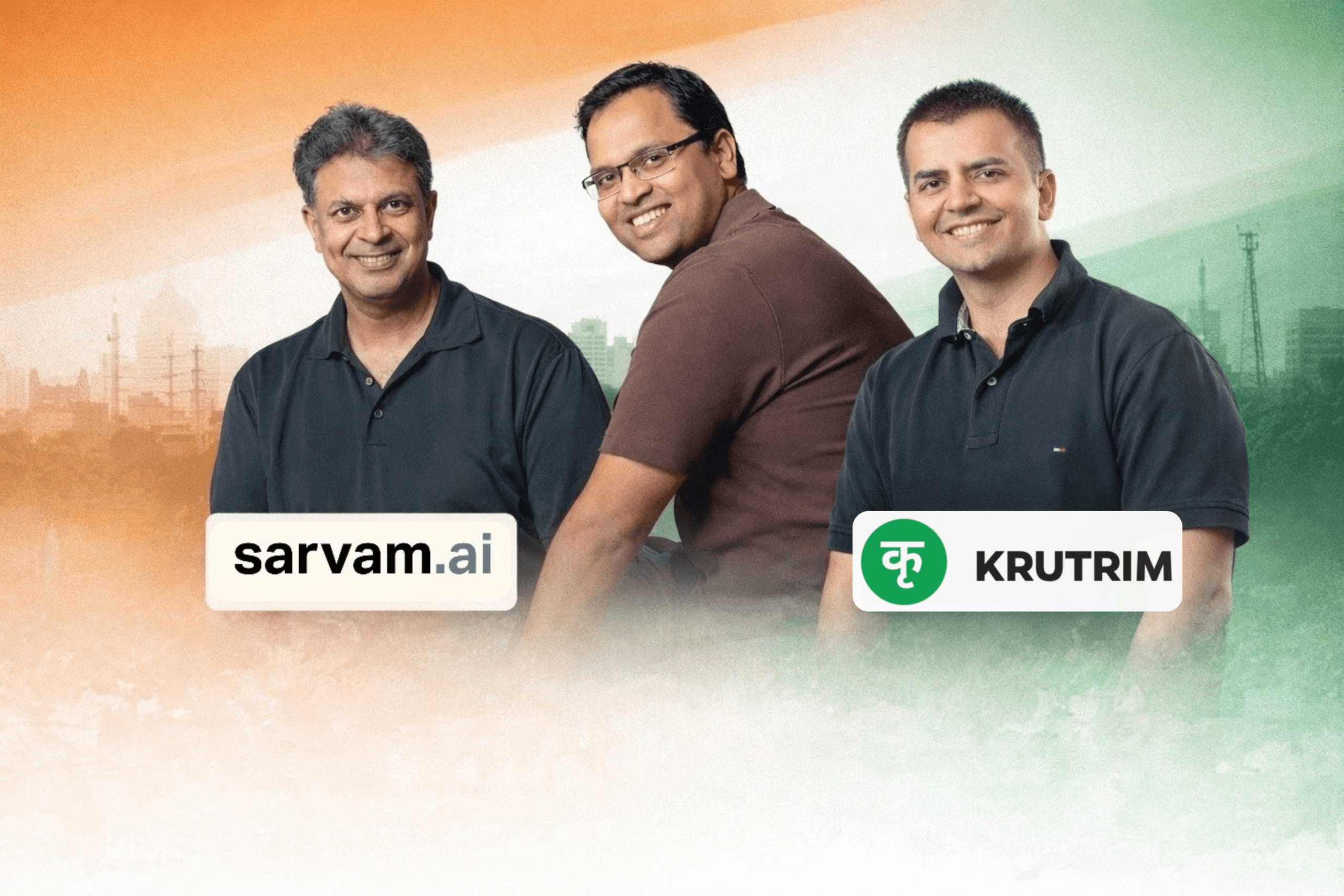
In January 2024, a startup called Krutrim, founded by Ola’s Bhavish Aggarwal, became India’s first AI unicorn, valued at $1 billion barely weeks after it was announced. Two years later, in February 2026, a Bengaluru-based AI company called Sarvam launched two large language models at India AI Impact Summit in New Delhi models trained entirely from scratch, capable of understanding all 22 official Indian languages, and competitive on global benchmarks with models from OpenAI, Google, and DeepSeek.
These initiatives are part of a coordinated, government-backed, industry-driven national effort to ensure that India does not limit itself with consuming artificial intelligence but builds it.
First: Why Would India Want its Own AI?
It’s a fair question. When there is ChatGPT and Gemini, why to spend hundreds of crores building something from scratch when you can just use what Silicon Valley has already made? The answer has four parts: language, sovereignty, data, and money.
The language problem
India has 1.4 billion people. Only a fraction are fluent English users. The country has 22 constitutionally recognised languages, and hundreds of dialects. Most major global AI models like GPT-4, Claude, and Gemini, are predominantly trained on English-language data. They can handle Hindi or Tamil, but often poorly. They miss idioms, fumble with cultural references, and deeply struggle with code-mixed language, the way most Indians actually speak and type, mixing Hindi and English in the same sentence.
An AI built with Indian languages at its core, not as an afterthought, serves a fundamentally different and much larger population. For a farmer in Rajasthan asking about crop disease, or a student in Kerala using a voice assistant, the difference is whether the technology works for them at all.
The sovereignty problem
If every Indian hospital, bank, school, and government department runs on AI built by a foreign company, then India is dependent on that company’s pricing decisions, server availability, terms of service, and geopolitical standing. What happens if the company is sanctioned? Or raise prices? Or decides to restrict access? These are the kinds of decisions governments think about.
Building your own AI infrastructure is, at root, a question of national self-reliance. The same reason India has its own space program, its own nuclear capability, its own satellite network. Critical infrastructure should not be entirely outsourced.
The data problem
Training AI requires data; enormous amounts of it. When you use a foreign AI service, your queries, your documents, and potentially your data flow through that company’s servers. For sensitive government functions like tax records, Aadhaar data, healthcare, defence, this is unacceptable. Sovereign AI means sovereign data: Indian data, trained by Indian institutions, hosted on Indian infrastructure.
The economic problem
Every API call made to OpenAI or Google from India transfers money abroad. At scale, across millions of users, enterprises, and government services, this is a significant outflow. Building domestic AI creates domestic jobs, domestic revenue, and domestic capability that compounds over time.
“Sovereignty matters much more in AI than building the biggest models.” — Vivek Raghavan, Co-founder, Sarvam AI
The Government’s Bet: The IndiaAI Mission
In March 2024, the Indian Cabinet approved what is now the centrepiece of India’s AI strategy: the IndiaAI Mission, with a budget of INR 10,371.92 crore (approximately $1.25 billion) spread over five years. It is implemented by MeitY, the Ministry of Electronics and Information Technology. The mission’s stated vision: ‘Making AI in India and Making AI Work for India.’
It operates across seven pillars:
- Compute: Building a national GPU infrastructure for AI training and inference, available to startups and researchers at subsidised rates.
- Foundation Models: Funding the development of indigenous large language models trained on Indian data.
- Datasets: Creating the AIKosha platform, a national repository of high-quality, curated Indian datasets in multiple languages.
- Applications: Funding AI tools for healthcare, agriculture, education, and governance.
- Skills: Training AI talent through university programmes and AI labs in Tier 2 and Tier 3 cities.
- Startup Financing: Providing funding and support to deep-tech AI startups across growth stages.
- Safe & Trusted AI: Developing governance frameworks and safety guidelines for responsible AI deployment.
| Mission Budget: INR 10,371.92 crore (~$1.25 billion) over five years GPUs Deployed: 38,000+ (as of early 2026), exceeding initial target of 10,000 Compute Cost: INR 65 per GPU-hour; subsidised by 40% for eligible users Proposals Received: 506 proposals for foundational AI models as of April 2025 LLM-focused proposals: 43 out of 506 specifically targeting large language models Startups selected (foundation models): Sarvam AI, Soket AI, Gnani AI, Gan AI |
Notably, the government has also committed to building AI labs in Tier 2 and Tier 3 cities, a recognition that India’s AI talent and needs are not concentrated in Bengaluru and Mumbai alone. By July 2025, 27 such labs were operational, with more planned.
Sarvam AI: India’s Most Credible Frontier Effort
Of all the Indian AI efforts, Sarvam AI is the one most frequently held up as the benchmark, and for good reason.
Who they are
Sarvam AI was founded in July 2023 by Vivek Raghavan and Pratyush Kumar, both formerly of AI4Bharat, a research initiative at IIT Madras focused on AI for Indian languages. The company is headquartered in Bengaluru.
It has raised more than $50 million (precise valuation figures can fluctuate) in funding, with a valuation of approximately $200 million. Investors include Lightspeed Venture Partners, Khosla Ventures, and Peak XV Partners (formerly Sequoia Capital India).
What they have built so far
Sarvam’s progression has been methodical. They started with Sarvam-1, a 2-billion-parameter model released in October 2024, focused on Indian language understanding. Then came Sarvam-M, a 24-billion-parameter model with hybrid reasoning capabilities.
In February 2026, at the India AI Impact Summit in New Delhi, they announced their most ambitious models yet:
Sarvam-30B: A 30-billion-parameter model using a mixture-of-experts (MoE) architecture, a design that activates only a fraction of total parameters at a time, reducing inference costs. It supports a 32,000-token context window, optimised for real-time conversational applications. Pre-trained on approximately 16 trillion tokens of text.
Sarvam-105B: A 105-billion-parameter model with a 128,000-token context window, designed for complex reasoning and enterprise tasks. The company says it is competitive with DeepSeek R1, a model roughly six times its size, on multiple benchmarks. It also claims to outperform Google’s Gemini Flash on several metrics while being cheaper to run.
Additional models: A text-to-speech model, a speech-to-text model, and a vision model for document parsing were also released as part of the same suite.
Critically: these models were trained from scratch — not fine-tuned on top of existing open-source systems like LLaMA. The compute infrastructure was provided under the IndiaAI Mission, with data centre support from Yotta and technical support from NVIDIA.
On 20 February 2026, Sarvam released a beta version of the 105B model under the name ‘Indus’, available on iOS, Android, and the web.
“Today we show we can bring our own AI to a billion Indians.” — Pratyush Kumar, Co-founder, Sarvam AI, at the India AI Impact Summit 2026
Their mandate from the Government
In April 2025, the Ministry of Electronics and Information Technology formally selected Sarvam AI to build India’s Sovereign LLM Ecosystem, specifically tasked with developing an open-source 120-billion-parameter model to enhance governance and public service access. Use cases include ‘Citizen Connect 2047’ and ‘AI4Pragati’.
Sarvam has also partnered with UIDAI, the authority behind Aadhaar, to integrate AI-based voice interactions and multilingual support into Aadhaar-related services. A user who doesn’t speak English will be able to interact with government ID services in their own language.
Krutrim: The Unicorn With a Complicated Story
No article on India’s AI is complete without Krutrim, and no honest article on Krutrim can skip its turbulence.
The ambition
Krutrim was founded in late 2023 by Bhavish Aggarwal, the serial entrepreneur behind Ola Cabs and Ola Electric. The name means ‘artificial’ in Sanskrit. In January 2024, it raised $50 million led by Matrix Partners India, achieving a $1 billion valuation and becoming India’s first AI unicorn, and, it claimed, the fastest startup in Indian history to reach that milestone.
The vision was sweeping: not just a language model, but a complete AI computing stack — from chips to data centres to models to applications. Aggarwal committed INR 2,000 crore personally, with plans to scale to INR 10,000 crore. In February 2025, Krutrim launched an AI lab and released several models: Krutrim-2 and Krutrim-1 (general LLMs), Chitrarth-1 (vision-language), Dhwani-1 (speech processing), and Krutrim Translate. It also launched Krutrim Cloud, a computing service for developers.
The reality check
Despite the ambition, Krutrim has faced well-documented challenges. Multiple senior executives departed within a year, including its business head and engineering leaders with decade-long tenures at Intel, who had left stable careers to join the mission. Reports from Outlook Business described leadership instability, unclear direction, and flagging user traction. The Krutrim AI app had recorded around 100,000 downloads as of late 2024, a modest number by any measure in a country where ChatGPT has over 110 million users.
Aggarwal also pledged Ola Electric shares, over 10 crore shares in total across multiple tranches, as collateral to raise debt for Krutrim’s data centre operations, a move that drew scrutiny given Ola Electric’s declining financial performance.
To be fair: building AI infrastructure is hard and expensive, but also slow. Krutrim’s chip ambitions like designing and manufacturing India’s first AI chip, remain aspirational. The company announced an AI chip target for 2026, but as of early 2026, no such chip has been publicly launched.
Where it stands
Krutrim remains an important player in India’s AI story, both for what it has built (a functioning AI cloud, a suite of models, real developer usage) and as a reminder that unicorn valuations and sweeping ambitions don’t automatically translate into world-class products. It is a work in progress, watched closely by the entire ecosystem.
The Wider Ecosystem: Other Players Worth Knowing
Sarvam and Krutrim get the most press, but India’s AI model landscape is broader:
BharatGen: Described as the world’s first government-funded multimodal large language model initiative, BharatGen is a consortium effort involving premier Indian academic institutions. It has developed a 17-billion-parameter MoE model and is focused on all 22 official Indian languages. Under the IndiaAI Mission, BharatGen received INR 900 crore in funding.
Soket AI: Selected under the IndiaAI Mission to develop a 120-billion-parameter open-source foundation model with a focus on India’s linguistic diversity. Its target sectors include defence, healthcare, and education.
Gnani AI: A conversational AI platform that launched its own model in February 2026, focused on voice AI and multilingual interactions.
Gan AI: Selected under the IndiaAI Mission to build a 70-billion-parameter multilingual model targeting text-to-speech, with support for all 22 Indian languages.
AI4Bharat (IIT Madras): An academic initiative, the organization where Sarvam’s founders came from, that has produced foundational research, datasets, and models for Indian languages. Considered the backbone of India’s indigenous NLP research.
Tech Mahindra’s Project Indus: One of India’s largest IT firms, Tech Mahindra developed Project Indus, an Indic language model. Its language models were reportedly processing 100 million queries per month by 2025.
What Does ‘Make in India’ Actually Mean in AI?
This is where we need to be precise because ‘Make in India AI’ is not a simple binary.
Building a large AI model involves several distinct components, and India’s sovereignty varies across each:
The model architecture: This is the mathematical design, the blueprint of how the AI is structured. Sarvam’s models use a mixture-of-experts architecture. This design approach is well-established in global AI research. The specific implementation and tuning is Sarvam’s own work.
The training data: Sarvam’s models were trained on Indian-language datasets, including text in Hindi, Tamil, Telugu, Kannada, Bengali, Marathi, and other languages, curated specifically for this purpose. This is actually indigenous. The AIKosha platform created by the IndiaAI Mission also provides a national dataset repository to support this.
The training itself: Sarvam’s models were trained using compute resources provided by the IndiaAI Mission’s GPU infrastructure, hosted in Indian data centres (including Yotta’s facilities) with technical support from Nvidia. The chips are predominantly NVIDIA H100s, American-made hardware. India does not yet manufacture its own AI chips, though both Krutrim and the government have stated this as a future goal.
The model weights: The trained model, the actual AI, is built by Indians, funded by Indian institutions, on Indian soil. This is amazing in the most meaningful sense.
Open or closed? Sarvam’s models are open-source. This means any Indian company, researcher, or developer can download and build on them. This is a deliberate policy choice, and a significant one.
So: the brains are Indian. The language data is Indian. The researchers are Indian. The training happened in India. But the chips, for now, are still NVIDIA’s. That last part is the honest caveat.
“India could do a Mangalyaan in AI.” — Gautam Shroff, IIIT Delhi — referencing India’s cost-efficient, successful Mars mission as a template for AI ambition
India in the Global Picture
India is not alone in this pursuit. Across the world, countries are realising that depending entirely on American or Chinese AI carries real risks.
France has Mistral AI, a startup that has built competitive open-source models and carries the banner of ‘European AI sovereignty’. The UAE has Falcon, built by the Technology Innovation Institute in Abu Dhabi, a government-backed research effort that produced models that were, for a time, among the best open-source models in the world. China has its own ecosystem entirely: DeepSeek, Qwen (Alibaba), Ernie (Baidu), and many others.
India’s moment was arguably accelerated by DeepSeek. When China’s DeepSeek released a model in early 2025 that matched GPT-4-level performance at a fraction of the cost, it sent shockwaves through the global AI industry, and gave India a kick. As Jaspreet Bindra of AI&Beyond put it: ‘DeepSeek is probably the best thing that happened to India. It gave us a kick in the backside to stop talking and start doing something.’
Sarvam is also eyeing a market beyond India. Indian AI startups are increasingly looking to export their models to other developing economies in the Global South, countries where neither US nor Chinese models are seen as neutral options, and where an affordable, multilingual, culturally aware AI from India may find a ready audience.
Challenges
It would be dishonest to write this article without acknowledging what India is still working through.
Scale gap: Sarvam is valued at around $200 million. OpenAI is valued at $500 billion. Anthropic at $380 billion. The funding gap between India’s best AI startups and the global leaders is enormous. More parameters, more compute, more researchers, more data — all require more money.
Chip dependency: Training frontier AI models requires GPUs, overwhelmingly, NVIDIA’s. India does not manufacture these. Any plan for genuine AI self-sufficiency eventually runs into the chip question. The IndiaAI Mission’s GPU infrastructure is real and significant, but it relies on imported hardware.
Talent: India has extraordinary AI talent, much of which is abroad, in Silicon Valley, at DeepMind, at OpenAI. Repatriating or retaining this talent within India requires competitive salaries, world-class infrastructure, and a research culture. This is improving but remains a challenge.
Execution: Krutrim is an honest reminder that ambition and capital don’t guarantee outcomes. Building AI is hard, and building AI infrastructure is even harder. The gap between announcement and working product is wide.
Data quality: India’s linguistic diversity is an advantage in theory but cleaning, curating, and structuring that data for AI training at scale is a massive, ongoing, largely unglamorous undertaking.
The Bottom Line
India’s sovereign AI story is real, but it is still being written. The IndiaAI Mission has deployed INR10,000+ crore and 38,000+ GPUs. Sarvam AI has built and launched competitive models, trained from scratch, in Indian languages, on Indian infrastructure. The other startups are following. And even the government is investing seriously and coherently.
‘Make in India AI’ means something today in a way it did not three years ago. It means models built by Indian researchers, trained on Indian data, hosted on Indian compute, open-sourced for Indian developers, even if the underlying chips are still NVIDIA’s.
Whether India becomes a global AI leader or a capable regional player serving its own population’s needs is still an open question. But the bet has been placed, the infrastructure is being built, and the work is genuinely underway. That, in itself, is a significant shift.
Disclaimer: This article is an analytical piece based on independent research by our editorial team using publicly available information as of the date of publication. It is intended for informational purposes only and does not constitute investment advice or endorsement of any organisation mentioned.
Related reads:
1. Ministry of Education Pushes AI Into Indian Classrooms; IIT Madras Gets Dedicated Centre of Excellence
2. OpenAI, Tata Group Team Up to Anchor India’s Largest AI Datacenter
3. Microsoft Elevate to Target 2 Million Indian Teachers by 2030