© 2026 NervNow™. All rights reserved.


Analysis: Did Companies Fire Too Fast for AI?
Did companies fire too fast for AI? Ford and Klarna are rehiring, and new data shows how much of the AI layoff wave was cost-cutting in a nicer outfit.
NervNow
AI & Work
Analysis · AI & the workforce
Did Companies Fire Too Fast for AI?
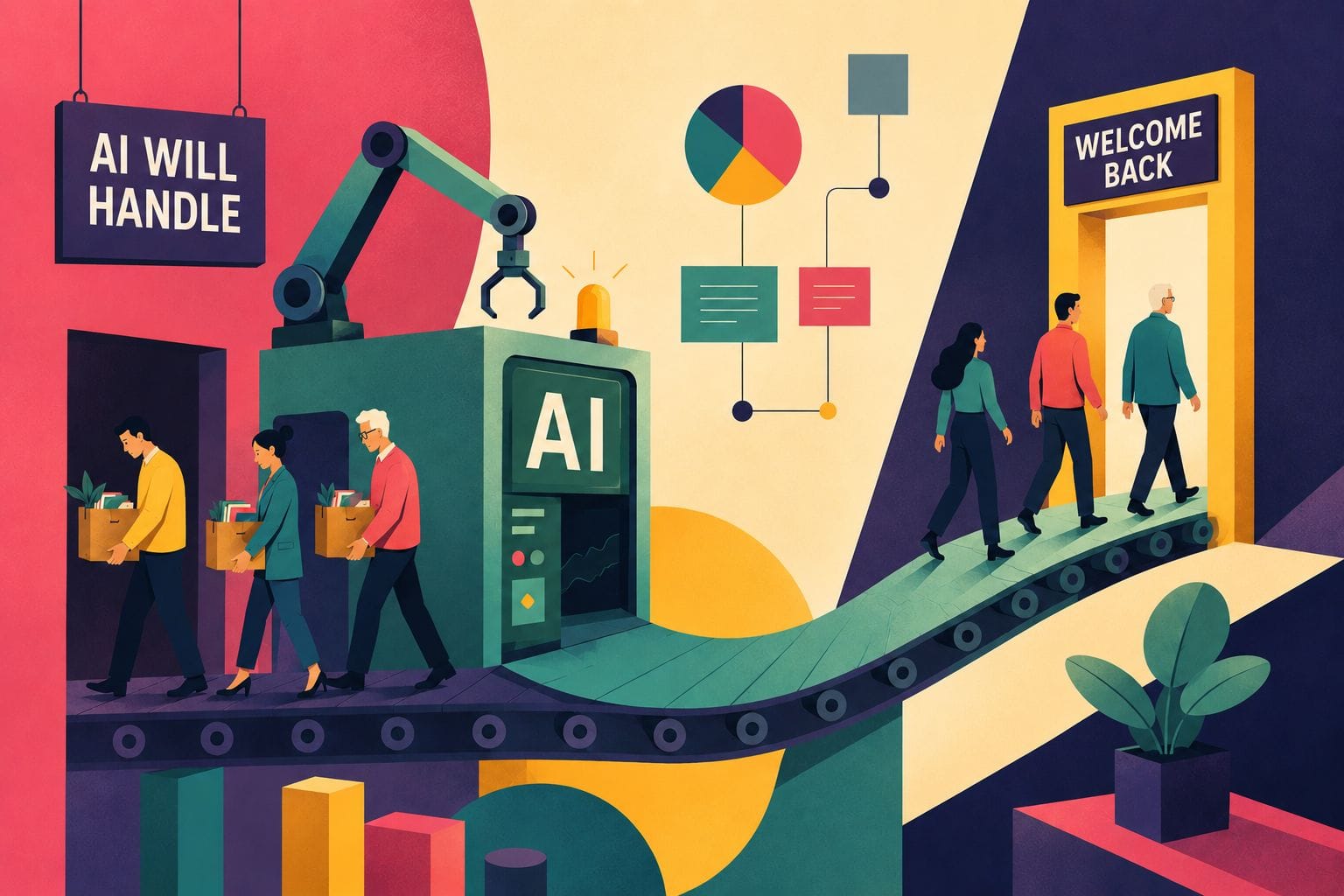
When companies cut jobs and pointed at AI, investors cheered. Now some of them are hiring people back and saying a lot less about it.
For three years Ford has been hiring back the engineers it thought software could do without. The automaker brought back or brought in about 300 veterans, the ones it calls its gray beards, after its automated quality systems kept waving through defects that an experienced human would have caught. The work paid off last week, when Ford topped the mass-market rankings in the J.D. Power 2026 U.S. Initial Quality Study, its first time there since 2010, with only premium brands like Porsche scoring higher across the whole industry.
Charles Poon, who runs vehicle hardware engineering at Ford, told reporters the company had badly misjudged what the technology could do on its own. AI is “only as good as the information you use to train it,” he said, and too many of Ford’s most experienced people had already left before anyone thought to capture what they knew. Chief Executive Jim Farley told Bloomberg the fix is showing up on the balance sheet, in warranty and recall costs he put at hundreds of millions of dollars in savings.
Ford is being unusually blunt about it. Plenty of other companies are doing the same thing with less to say. Over the past year, firms that cut staff and gave AI the credit have started hiring people back, and the second announcement never gets the same billing as the first. Which raises a question that stings if you were one of the executives who moved early. Did companies fire too fast for AI, and was AI even the real reason.
AI is only as good as the information you use to train it.Charles Poon · Ford VP of vehicle hardware engineering
The hiring data already shows it
Robert Half put the question to hiring managers and found that 32 percent had cut a role mainly because of AI, then turned around and rehired for the same job or something close to it. Gartner expects that by 2027, half the companies that pinned customer service cuts on AI will be staffing those desks again, often with a new title on the door. Visier, which watches rehiring across millions of workers, clocked 5.3 percent of laid-off employees coming back to their old employer, the highest that number has run since 2018.
The people who signed off on these cuts are not feeling great about them either. Orgvue asked more than 1,000 senior executives in early 2025 whether AI had driven any of their layoffs. Thirty-nine percent said yes, and of that group, 55 percent said the call was wrong. Worth being careful with that 55 percent, because it describes the leaders who cut, and a lot of coverage has since inflated it into a majority of all employers. Forrester, whose own regret number gets quoted everywhere, lands in similar territory and puts the eventual walk-back at about half of AI-attributed cuts, with the jobs often reappearing offshore or on lower pay.
The reversal, by the numbers
32%
of U.S. hiring managers cut a role mainly for AI, then rehired for the same job or something close to it
Robert Half
50%
of companies that blamed customer service cuts on AI are expected to restaff those desks by 2027
Gartner
5.3%
of laid-off staff are being rehired by former employers, the highest rate since 2018
Visier
Klarna is the one everyone points to
If you want the whole arc in one company, look at Klarna. In February 2024 the Swedish payments outfit put out a press release with OpenAI saying its AI assistant was fielding two-thirds of customer chats and doing the work of 700 agents. That line became the headline for the whole replace-the-humans idea. The company had dropped its headcount by more than a thousand, which Klarna chalked up to AI and a long hiring freeze.
By the spring of 2025 the story had flipped. Chief Executive Sebastian Siemiatkowski told Bloomberg that Klarna’s AI-driven cost-cutting had gone too far and that the company was recruiting people again so customers could always reach a human. Leaning so hard on cost, he said, had left the service at “lower quality.” The new jobs are remote and loosely structured, pitched at students and people living away from the big cities.
Klarna, for its part, hates the word reversal. The company says its AI now does the work of more than 800 roles, that it never got rid of human support in the first place and that the latest hiring only adds to what it already runs. Both readings can be true. The technology really did keep scaling, and Klarna still decided it had automated past the point where human judgment was doing real work.
But were these AI layoffs in the first place
This is where the neat regret narrative gets complicated. A fair amount of what got sold as AI-driven restructuring turns out, on a closer look, to be plain old cost-cutting in a nicer outfit. Gartner talked to 321 customer service leaders in October 2025 and found that only 20 percent had cut staff because of AI. Most had kept their headcount steady while handling more customers, the pattern you see when AI is helping people get through the work faster.
A different Gartner study, this one of 350 executives at billion-dollar companies, found that 80 percent had made cuts after piloting AI, and that those cuts had no real bearing on whether returns improved. Sam Altman of OpenAI has put a name to the move. He calls it “AI washing,” companies blaming AI for layoffs they were going to make anyway. Oxford Economics got to a similar place from another direction, pinning most of the so-called AI layoffs on weak demand and past overhiring that needed unwinding no matter what the software did.
The irony is that the loudest AI layoffs have tended to be the ones with the least evidence behind them. Block cut about 40 percent of its staff, Chief Executive Jack Dorsey put the blame straight on AI, and the stock popped. Block had also roughly tripled its workforce during the pandemic, and critics were quick to note that a lot of what Dorsey framed as an AI decision looked like the unwinding of that hiring binge. Whether the bet pays off depends on whether the software can carry the load those workers were carrying, and that answer is not in yet.
The firms that added AI and kept hiring
The companies that look smartest right now are the ones that aimed AI at tasks and kept hiring people around it. IBM is the obvious case. Its AskHR bot swallowed most of the routine HR questions and, by Chief Executive Arvind Krishna’s account, took over the work of a few hundred staff. IBM’s total headcount went up anyway, Krishna said, because the money it saved went into hiring engineers and salespeople.
And now IBM is doing the opposite of what everyone else is doing. Nickle LaMoreaux, its HR chief, says the company will triple entry-level hiring in the U.S. this year. Her argument is that companies gutting their junior ranks to look AI-forward are setting themselves up for a mess in a few years, when there is nobody left to promote. AI can do a lot of the old entry-level work, she grants, so “you have to rewrite every job” around whatever people are still better at.
The cost of hitting undo
Undoing a layoff is expensive. You usually pay more the second time, eat the recruiting and onboarding costs again and lose whatever the departing person knew that never made it into a document. Forrester’s guess that a lot of these roles come back offshore or on lower money describes a workforce returning on worse terms than it left on.
So did companies fire too fast. A lot of them did, and a good number were never really firing for the reason they gave. Even the true believers have dialed it back. Dario Amodei of Anthropic spent last year warning that AI could wipe out half of entry-level white-collar jobs, and has since reframed it as something closer to augmentation, arguing that the work left over tends to expand, though he warns the technology is moving faster than past ones and might not leave time for that gentler outcome to arrive. The layoffs that were meant to prove the future had arrived are starting to read like a rough first draft, one that a lot of companies are busy editing without drawing attention to it.
Some of those cuts were structural and will hold. The rest were a bet that the future had already arrived, and a growing number of employers are finding out it had not.
Sources
- Ford’s quality turnaround and rehiring — Fox Business and Yahoo Finance
- Hiring managers rehiring after AI cuts — CNBC
- Gartner, Visier and Forrester findings — Human Resources Director
- Survey on regretted AI redundancies — Orgvue
- Klarna’s reversal and rehiring — Bloomberg, Fortune and Forbes
- Gartner ROI study, Oxford Economics and Amodei — Fortune
- Sam Altman on “AI washing” — Fox News
- Block’s AI-attributed layoffs — Fortune and CNN
- IBM’s AskHR and entry-level hiring — Entrepreneur and CIO
The AI business brief, in your inbox
NervNow tracks how AI is reshaping work, strategy and the companies that lead. Join the leaders reading it first.
Subscribe free© 2026 NervNow. Analysis for business leaders navigating AI and technology.