© 2026 NervNow™. All rights reserved.


What’s Really Limiting India’s Data Centers Growth?
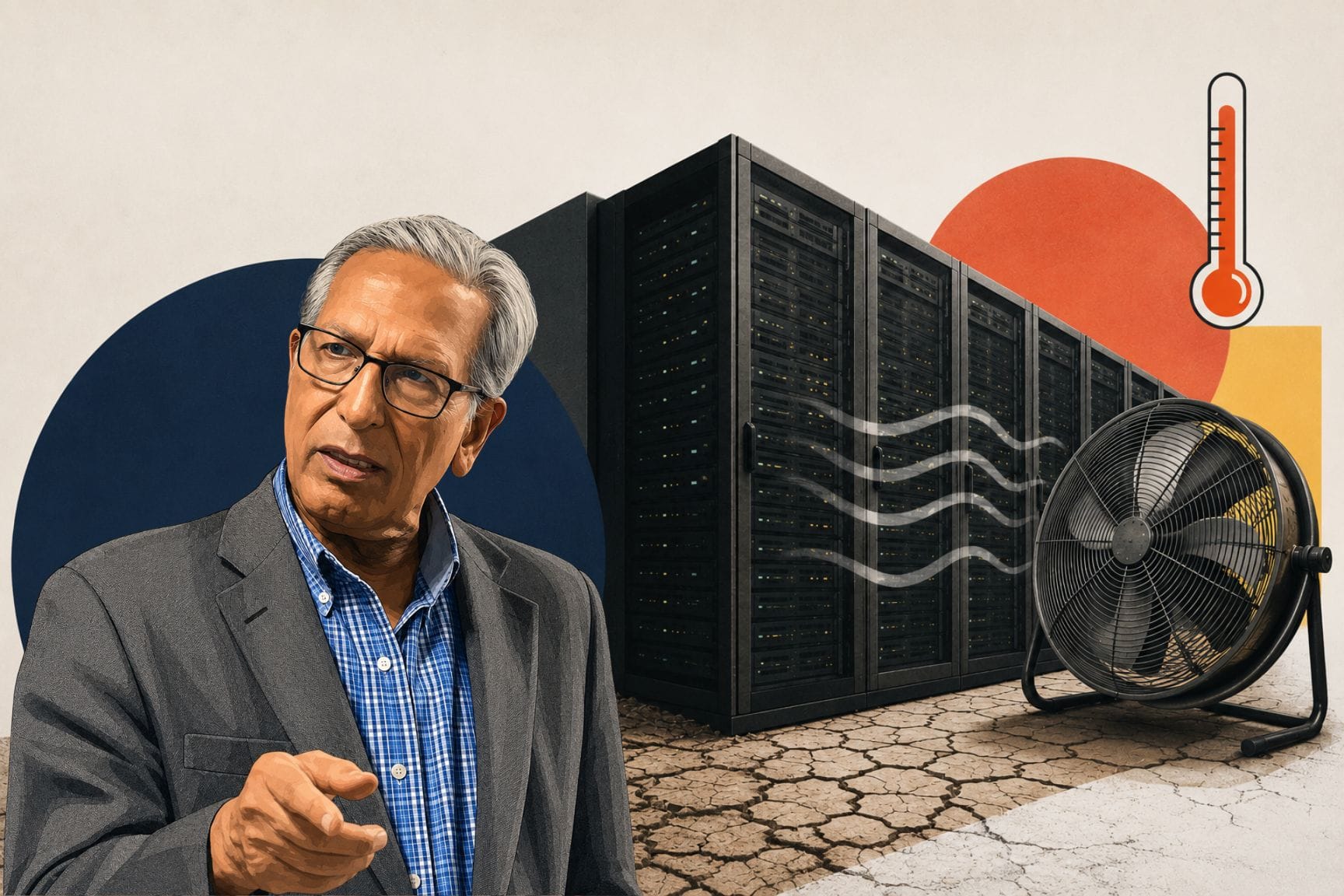
India is building data center faster than it can cool them. Prof. Roop L. Mahajan on why heat, not machinery, is the real limit, and how coal could fix it.
Op-Ed
Infrastructure | Data Centers & Materials
Prof. Roop L. Mahajan, Founding Director, Institute for Critical Technology and Applied Science, Virginia Tech, writes on the hidden bottleneck in India’s data center boom: heat. India crossed 1,700 megawatts of capacity in 2025 on 56 billion dollars of investment, and every announcement counts megawatts, acres, fiber routes, subsidies. Almost nothing counts heat. Mahajan argues that heat is a materials problem before it is a machinery problem, and that the raw material for the fix, coal-derived graphene, is already beneath India’s feet.
1,700 MWIndia’s data center capacity as of 2025, per the CBRE report
$56BData center investment in India in 2025 alone, per the CBRE report
40 kWApproximate ceiling for air-cooled racks per rack
Part I
The physics nobody budgets for
India crossed 1,700 megawatts of data center capacity in 2025, on the back of 56 billion dollars invested that year alone. Every announcement counts the same things: megawatts, acres, fiber routes, subsidies. Almost nothing counts heat. That is a mistake, because the ability to keep next-generation AI hardware within safe operating temperatures may become one of the defining constraints on India’s data-center buildout.
That is a mistake, because the ability to keep next-generation AI hardware within safe operating temperatures may become one of the defining constraints on India’s data-center buildout.
A modern AI accelerator such as Nvidia’s H100 draws approximately 700 watts. Next-generation AI compute modules are already pushing beyond 1,400 watts. Pack seventy-two of them into a rack, as Nvidia’s GB200 system does, and a single rack integrating GPUs, CPUs, networking and other supporting electronics can dissipate up to 132 kilowatts. The thermal challenge becomes immediately apparent.
Ten years ago, a full rack drew 5 to 10 kilowatts. Air cooling, the technology most Indian facilities were designed around, hits a practical ceiling near 40 kilowatts per rack: air cooling becomes increasingly inefficient and difficult to implement as we approach this level of heat dissipation.
The cost shows up on the electricity bill. In a conventional data center, cooling can account for 30 to 40 percent of a data center’s total energy consumption. When a chip runs hot, it throttles itself: the processor automatically reduces clock speeds to protect itself. An expensive GPU cluster running at reduced clock speed is capital sitting idle because of heat.
India adds one more variable. Summer temperatures across much of the country sit between 35 and 45 degrees Celsius for months at a time. Every degree of outside heat is capacity the cooling plant must buy back before it does any useful work. This is not a weakness of Indian engineering. It is a boundary condition, and boundary conditions decide which technologies win. It means the return on better thermal materials is higher in India than almost anywhere else.
Illustrative, not to precise scale. Rack power figures vary by vendor configuration and are cited in the sources note below.
Part II
Heat is a materials problem before it is a machinery problem
I spent fifteen years at Bell Labs working on thermal management in semiconductor manufacturing, and three decades in academic research on heat transfer since. One lesson repeats. Before any chiller, cold plate or cooling tower can do its job, heat must first travel out of the silicon, across a series of solid interfaces, and into a fluid. Much of the thermal resistance resides within those first few millimeters, and those millimeters are governed by materials.
Liquid cooling is rapidly becoming the preferred solution for the highest-density AI systems, and rightly so. But liquid cooling does not eliminate the need for better materials. Before heat ever reaches a cold plate or coolant, it must travel from the silicon, across package structures, thermal interface materials and heat spreaders. Improving those thermal pathways lowers junction temperatures, enhances reliability and allows the cooling system itself to operate more efficiently.
This is where graphene and its family of carbon nanostructures enter the picture. Pristine graphene possesses exceptionally high in-plane thermal conductivity, several times better than copper. However, practical graphene-based materials such as multilayer graphene, graphene oxide, graphene quantum dots and graphene composites achieve more modest but still significant improvements and are increasingly being engineered for thermal management applications. Each has a place in the thermal chain, and the applications are further along than most people assume.
Switch between the four points in that chain below.
Start with the humblest component in the stack: the thin layer of paste or pad between a chip and its heat sink. Although easily overlooked, this thermal interface material often contributes one of the largest thermal resistances in the heat flow path.
Graphene-enhanced interface materials can significantly reduce that resistance, allowing a processor to sustain higher performance at the same junction temperature or achieve the same performance while running cooler.
Thin graphite and graphene heat spreaders perform the next task, spreading concentrated heat away from local hot spots before it reaches the cooling system.
Smartphone manufacturers already ship hundreds of millions of devices using graphite-based heat spreaders. As AI hardware pushes power densities ever higher, these materials are increasingly finding their way into servers and accelerator modules.
Further along the thermal pathway, graphite and graphene-based foams offer an attractive combination of high surface area and excellent thermal transport. Used as engineered structures within heat exchangers or cold plates, they have the potential to increase heat transfer without increasing system size. That matters when rack space is priced by the square meter.
As operators begin exploring two-phase liquid cooling, where performance depends on how efficiently surfaces nucleate boiling and shed condensate, graphene-based coatings are emerging as a promising way to optimize both processes.
Finally at the building scale, insulation panels made from recycled plastics reinforced with graphene oxide nanofillers can reduce the cooling load before it ever reaches the chillers.
Although the heat generated by the servers remains the dominant cooling challenge, better building envelopes become increasingly valuable in hot climates such as India’s. They also transform plastic waste into durable construction materials, advancing sustainability alongside energy efficiency.
Much of the thermal resistance in a data center sits in the first few millimeters, and those millimeters are governed by materials.
None of this is merely laboratory speculation. Several of these technologies are already in commercial use, while others are advancing rapidly from laboratory research toward industrial deployment. What is missing is manufacturing scale, and a coherent feedstock strategy.
To advertise with us, write to nervnow.com/contact
Part III
The feedstock is under Indian ground
Here is the part of the story I find most consequential for India. Graphene and its relatives can be derived from coal. India holds among the largest coal reserves in the world, even as the energy transition is steadily narrowing coal’s future as a fuel. The same tonne of coal tells two different economic stories. Burned, it is worth its calorific value, once. Converted into graphene oxide or engineered graphite, or other advanced carbon materials, it becomes a feedstock for high value carbon materials that sell at many multiples of that value and feed industries that barely existed a decade ago.
Viewed this way, coal stops being a legacy liability and becomes a strategic materials resource. AI data centers could provide one of the first large-scale domestic markets for these advanced thermal materials. India is creating the demand while already possessing the raw material. What sits between them is a processing, qualification and commercialization gap, and that gap is closable.
Part IV
What would close the gap
Three steps would close it.
Pilot production lines
Lines that connect India’s coal research institutions with materials manufacturers, sized for tonnes rather than grams.
Qualification standards
Standards so that data center operators can specify coal-derived thermal interface materials or heat spreaders with the same confidence they specify chillers or servers.
Procurement commitments
Even one hyperscale campus committing to graphene-enhanced thermal components could pull an indigenous supply chain into existence and encourage investment across the chain.
Part V
The long game
India’s data center ambition is real, bold and well-funded. Whether that ambition reaches its full potential will be decided not by how many megawatts get built, but on how efficiently the heat gets out. The answer lies as much in materials as in machinery, and the raw material is already beneath India’s feet.
Get the next NervNow deep dive in your inbox
Reporting on the people, policy and money shaping enterprise AI, sent direct.
Subscribe to the newsletterProf. Roop L. Mahajan is the Lewis Hester Chair Professor of Mechanical Engineering and Materials Science & Engineering at Virginia Tech, and founding executive director of the university’s Institute for Critical Technology and Applied Science (ICTAS), where he now serves as Global Ambassador. He spent 15 years at AT&T Bell Laboratories in semiconductor manufacturing and thermal management. His current research focuses on coal-derived graphene and advanced thermal materials. The views expressed in this op-ed are the author’s own.
Sources & method
Edited for NervNow style; figures verified as of July 2026. India’s 2025 data center capacity, investment, and 2026 growth figures are from CBRE’s India Alternate Sectors Outlook 2026: total capacity crossed 1,700 MW in 2025 on 440 MW of new supply, investments reached $56.4 billion in 2025, cumulative commitments stood at $126 billion, and CBRE projects commitments to exceed $180 billion in 2026 alongside roughly 30 percent capacity growth. Nvidia’s H100 has a rated thermal design power of up to 700W depending on configuration. The 132-kilowatt GB200 rack figure is the author’s own; Nvidia’s published spec for a full NVL72 rack cites a lower figure of roughly 120 kilowatts, so readers researching further may see either number depending on configuration and source. The 40-kilowatt air-cooling ceiling and the 30 to 40 percent cooling-energy share are commonly cited industry figures rather than a single source. Author biographical details are drawn from Prof. Mahajan’s Virginia Tech and LinkedIn profiles. To flag a correction, write to editorial@nervnow.com.