© 2026 NervNow™. All rights reserved.


Anandh Mathew, Caliche: On Oil, Mining and the Industrial AI Nobody Wants to Fund
Anandh Mathew of Caliche on building industrial AI for oil, gas and mining, where data is often on paper and buyers move slowly.
Interview › Industrial AI › Energy and Mining
NervNow Interview Series
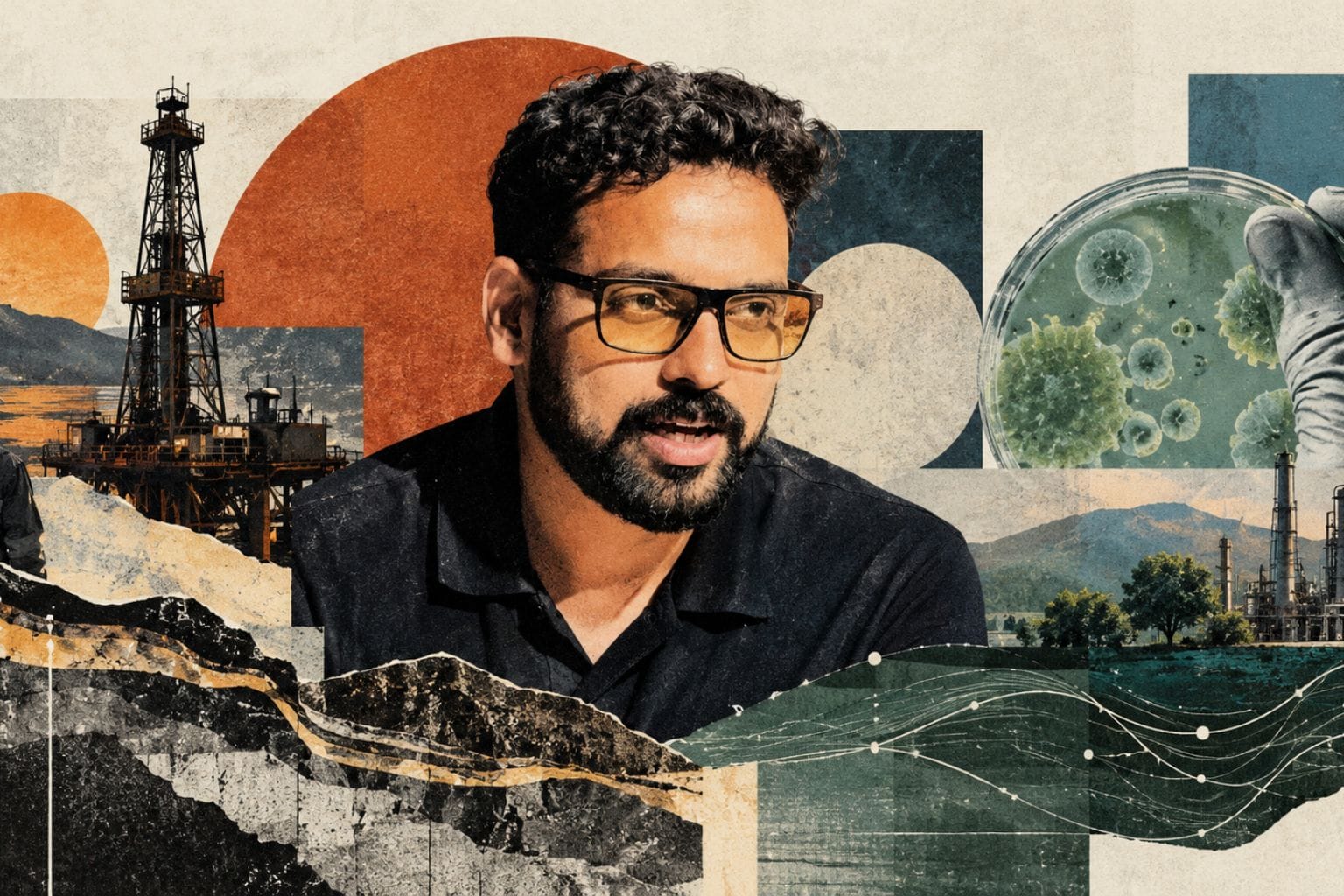
Anandh Mathew co-founded Caliche in Shillong, Meghalaya, in 2018 as an industrial biotechnology startup built around oilfield microorganisms. The company now runs two divisions, Industrial Biotech and Industrial AI, and works across oil and gas, mining, steel, aluminum and other critical industries. He speaks to NervNow about the pivot from scaling industrial biotechnology to building in-house Industrial AI, the difficulty of working with raw data in critical industries, and why operational returns in these sectors depend on capital spending, government incentives and a talent pool that does not yet exist.
Disclaimer
The views expressed in this conversation are Anandh Mathew’s own, shared in his personal capacity. They do not represent the positions of any organization he is affiliated with, or NervNow.
Anandh Mathew
Co-Founder and Chief Operating Officer, Caliche
Anandh Mathew co-founded Caliche in 2018 and serves as its chief operating officer. The company describes itself as an inventions’ company and works across oil and gas, mining, steel and aluminum, with divisions in industrial biotechnology and industrial AI. He studied petroleum engineering at the University of Technology and Management in Shillong and mining engineering at the University of Newcastle, and holds a master’s in psychology from Indira Gandhi National Open University. Before founding Caliche he worked as a mining consultant at KACPL and as a project planner at JAAC.
Part One: Industrial Origins and Process Optimization
NervNowCould you brief us on Caliche, what you are doing right now, and how AI is being adopted within it?
We started as an industrial biotech startup in 2018 in Northeast India. We were one of the first startups out of Meghalaya because my co-founder and I studied there. That is the reason we had an opportunity to think about a new idea. We were trying to solve a problem in the oil and gas sector, which had been a big issue for a long time. We were looking for an alternative, and we crafted a biotech-based solution.
That is how we started. We put together a strong team with a multidisciplinary approach, launched a couple of other initiatives, and finally deployed the product. It was going well, and then COVID hit. We were trying to sell biotech solutions to the industry, but the industry was not ready to adopt them due to the COVID situation. During COVID, selling microorganisms was itself a big challenge. You could not really think about selling microorganisms at that time.
That is when we started exploring other options and identified other areas where we could work. Since our expertise was in oil and gas, Industry 4.0 was booming at the time. We had to do something with our team, because we were burning a lot of money. That is how we entered industrial AI.
We initially started developing an AI-driven platform specifically for processing oil and gas data. Because this data is classified as national property in India and is not publicly accessible, our challenge was to extract maximum value from the limited datasets that already existed. Traditionally, oil and gas exploration is a highly time consuming process that requires juggling multiple fragmented software tools and relying heavily on manual expertise. To solve this, we leveraged AI to identify critical data points, allowing us to streamline the entire process and analyze the data much more quickly and efficiently
NervNowHow exactly do you get this data, since only a limited amount is available?
Accessing historical industry data required submitting formal proposals to the relevant regulatory bodies. To build our initial models, we leveraged international open-source research datasets. Over time, we secured enough access to restricted domestic data to successfully validate our work.
Ultimately, the primary challenge wasn’t just data access, but data format. A significant portion of historical records in the oil and gas sector existed only as physical charts and paper documents. Before any advanced analysis could begin, we had to process and digitize this raw, physical data.
This initial work naturally led to the development of our artificial intelligence capabilities, ultimately resulting in dedicated operational and AI divisions. We subsequently applied this same AI driven logic back to our core research. Traditionally, experimental research relies heavily on manual, trial and error testing. By integrating AI, we can now optimize experimental variables, identify ideal input compositions, and accurately predict long term outcomes before physical testing even begins. This predictive modeling significantly reduces the number of manual iterations required.
The problem was not with data access. The problem was that not all of the data was in digital form. Most of this data existed as charts and paper.
Part Two: Process-Level Decisions and Microbial Model Twins
NervNowSo this is not at the positioning level, it is at the process level. What decision is it making, and what would you be doing manually without it?
In a controlled laboratory environment, variables are strictly managed, and the resulting data is entirely proprietary and well understood from end to end. However, in real-time industrial applications, continuously monitoring these active processes traditionally requires heavy manual oversight. Basically we need more manpower.
To solve this, we developed a digital twin framework that simulates the exact characteristics of the physical subject. By adjusting inputs within the virtual model, we can forecast expected behaviors. Once we identify the optimal reaction in the simulation, we then execute those specific changes in the physical lab. This helps our clients also to understand the biological process that is happening in the backend of a technology deployment.
NervNowHow do you build this AI system, since microbial behavior is unpredictable? How do you ensure accuracy?
We leveraged our extensive historical data by feeding it into a proprietary, in house AI system. We consciously chose not to adopt an off the shelf solution; instead, our engineering team built the architecture from the ground up.
The resulting system is purpose built rather than universal. It is trained exclusively on our highly specialized, domain specific datasets and is designed to operate accurately only within our specific operational parameters. This is for our internal operations and R&D as well as sales activities.
NervNowWhat accuracy are you seeing from it?
When we started we were at roughly 70%. We kept feeding in data and cross-validating the processes, and we are now above 85%. I would not claim it is above 90%, so you can keep it between 85% and 90%.
It is very specific to specific problem statements. Since it is multi-variable, if instability is high the result will change and efficiency will drop. If instability is low, efficiency increases. In some cases we hold 15 to 20 parameters. If those parameters change, we check the effect on that particular microorganism.
NervNowHow do you maintain that across different industrial sites using only these parameters?
The same way. Whatever we are doing, we have done it in the lab. We will not just say, “Okay, AI is doing it, so we will not do it.” No. We do it, and then we validate with AI as well. If that particular combination works, we try it again in the lab. We reproduce it.
We follow the same process for the microbial carbon capture work we have. There it is the same approach for gaseous composition: which microorganism can work under what gaseous composition, and we check using AI.
What we developed is a model kind of twin that can pretend to be a microorganism with the same characteristics. The most desired change, we then make in the lab.
Part Three: Data Pipelines and Multidisciplinary Training
NervNowComing back to the data pipeline, how is the data actually collected, cleaned and fed in? How difficult is it to train a model for a live industrial environment?
Let me tell you one thing about oil and gas data. We work in critical sectors: oil and gas, mining, etc. We started with oil and gas, then expanded into mining, and a couple of other sectors, including aluminum. We are among the best in AI solutions for the aluminum industry.
The data was very complex for oil and gas, because it is not public. You either had to buy it or rely on the government to get it, and back in 2019 our access to data was very limited.
When we did get access to some of it, the challenge was how to annotate it. As a petroleum engineer, I might understand the data, but the engineer writing the code will not understand any of it. So we had to hire geophysicists and people with a geology background and have them sit with the AI people, so each side would learn the other’s field.
We trained the team that handles our industrial AI work by bringing people in from different sectors and training them in AI. The person who came with AI knowledge had no idea about oil and gas, and the person who came from geology had no idea about AI. They had to work it out between them, and they supported each other, and they learned. So it is the team who made the difference.
NervNowMost AI in oil and gas is built to optimize extraction. Find more, faster, cheaper.
There are two things: process efficiency or production efficiency. Only these two work. If you are in the process sector, your data access is greater, because a more structured approach to data sharing and collection exists. When it comes to production, it is more conventional.
Part Four: Cross-Context Portability and International Operations
NervNowYou have deployed across India, the UAE and Australia. Is this model trained on data from oil refineries in Assam, or on other data as well?
We maintain strict compartmentalization across our different sectors. For instance, our energy sector platforms process data exclusively within that specific domain under highly secure conditions. Due to the sensitive, national nature of this information, our systems operate in strict compliance with the data localization and security mandates of the Ministry of Petroleum and Natural Gas (MoPNG), ensuring the data remains exclusively within authorized environments.
In the mining sector, the data landscape is more open. We leverage a significant amount of publicly available data from the Geological Survey of India (GSI). In alignment with national critical resource initiatives, we collaborate with the Ministry of Mines and GSI to develop in house software for specialized resource detection.
NervNowHow portable is your AI across these contexts, and how much retraining is required each time?
Our AI is highly portable by design, requiring minimal retraining of the foundational model. Because our very first project was exceptionally complex, we had to build a versatile platform capable of handling a wide spectrum of data. To give you an idea of the variance, in oil and gas, we are processing data from four to five kilometers underground.
In mining, we are looking at depths of just 100 to 200 meters. The data visibility and collection methods are vastly different. However, the core logic processing complex, subterranean datasets remain more or less the same.
NervNowHow does accuracy hold up overseas? Does it work as efficiently in the UAE or Australia?
In mining, Australia has better datasets, so it works pretty well there. For the UAE, I think they do not really need much data, because exploration is not a big game there. You can dig almost anywhere and find oil, so technically you should be at 100%, but their requirement is very low.
NervNowWhich country is the most challenging right now?
The toughest data we have processed is Nigeria. That was very tough. It was complex, the data was not structured, it was completely raw, and we had to do a lot of pre-processing, which is very expensive. The Nigeria dataset was the most expensive one we have done.
The core logic is the same. It is processing complex datasets. We just change the dashboard. The UI and UX change, but the core logic stays the same.
Part Five: Commercial Scale, B2B Entry Barriers and Technical Approval
NervNowYou work with public sector undertakings such as ONGC, Oil India and Indian Oil. These are organizations with deep technical scrutiny and long validation cycles. How does getting an AI-driven solution through their technical approval process actually work?
I will tell you directly: it would be easier for me to go abroad, build that expertise there, come back here and then propose. They might agree faster. But the problem is simple. If I ask for a development order, say I want to run a pilot, everybody is happy. I tell them, “You do not have to pay me anything. I will give you a pilot, you put in your resources, I put in mine, we do it on your site and process it for you, and you do not pay me anything.” That is fine.
The moment I say I am going to charge, maybe per square kilometer, the game changes. Getting into these companies means going through a tendering process. Now you are competing with companies that have been in this industry for decades, who have legacy work here. At some point you will fail to meet the required qualifications in the tender. They will always have an upper hand there.
The Government of India recently created a provision for startups, and it is working well. But the alignment of these decision-makers will always be toward an established company. If they have to choose between a startup and MNC, they may choose MNC. Why risk it with a new company?
The barrier to entry is very much there. It has been reduced a lot, but it still exists. If I try the same thing in another region it is a little easier for me. And this barrier is a one-time barrier. Once you are in, you have regular orders.
Our current approach is to work through MoPNG, so we are getting a couple of jobs. ONGC and Oil India Limited give us opportunities too. But at a commercial scale, these barriers will definitely be there. But, it is all about how consistent you are in trying so, we never give up.
Imagine I tell you it is going to take you one year to write a book, and I tell you I can write that book in five minutes, with more precision. Would you accept that?
NervNowOf course not.
No, right? So that is the issue. But I think it is slowly changing, as people become more open to accepting these things. On the organizational side there are hurdles they cannot control. The tendering process, for example, is handled by the ministry itself, so they cannot do anything about it. I think it will change slowly, but acceptance is much better than it was five years ago.
Part Six: Human Intervention Protocols and Sector Decarbonization
NervNowWhen your system is deployed at an industrial site and the AI flags an anomaly, a microbial population collapse, an efficiency drop, an unexpected gas composition, what does the human intervention protocol look like? Where does AI authority end and operator judgment begin?
We never give full control to AI in these processes. Even when we sell it, we tell them it is a tool. It depends on the engineer or the operator who wants to use it. There is always scope for the user to reduce how much AI he relies on.
There is no full control with AI here. With every dataset we have and every process we follow, the platform does not create data itself. It cannot do that. We have to feed in the data, and it is all kept separate. And none of these AI platforms are connected to the internet. None of them. Everything sits on our internal server, or the company provides space for an in-house server, so it is not connected to the internet.
NervNowSteel, cement, oil and power are the hardest sectors to decarbonize and the ones where AI adoption is least visible. What is the honest answer for why AI has not moved faster in these sectors, and what would need to change?
The biggest challenge is the data. Nobody is collecting it. Take steel, which needs to be decarbonized soon. You can decarbonize in two ways: reduce emissions by capturing them, or eliminate them by improving your processes, which is where AI comes in. Say AI is implemented and you gain 20% process efficiency. Now you have a 10% reduction in emissions.
The steel industry does have equipment that generates a lot of data. All the new equipment can detect temperature, pressure, wear and tear, and most of it photographs the material passing through. None of that data is stored or analyzed. Nobody is doing it. Why? First, because they do not see the need.
Say my cost is 100 rupees (about $1.15) per kg of steel. My distributor pays me 110 rupees. I am making 10 rupees. I am making good money. I am fine. I am not going to change anything. Maybe I pay a carbon tax of 5% or so, and I am fine paying it right now. Why would I change the processes I am following?
You have to add value to this. I should either get better profit or reduce operating expenditure. So when somebody comes to me and says, “Sir, use our AI system and we will achieve 10% process efficiency for you,” my biggest challenge is that my system will not be able to produce the data they are asking for. It might not be there.
So I have to put in capital expenditure to install that system, and now it becomes costly. My cost of 100 rupees might rise to 105 rupees, and I make less profit. Over time I might make a profit, but nobody today is interested in an ROI horizon beyond five years. It used to be 10 years. Now people ask me, “What is the ROI? I need it in three years.” That is not possible, so that challenge comes up.
The infrastructure is not ready for adoption at most of these companies. Everything runs on conventional methods, and if you wanted to adopt, you would have to put in capex, which adds to the cost of the product you are building. That is the primary challenge. That is why, if you look, many companies are adopting it, but on a very small scale. In a big company one small department will use AI, not the whole organization.
The other thing I have seen is that people working on the ground are not exposed to this, so they do not understand how it works. A laborer working an eight-hour shift will not understand anything about AI. He knows about speed, trucks and roads. It is very hard to train him and make him understand how he now has to work.
Let me give you a reason. When I was working in a sector in Odisha, a company was providing an AI solution to stop laborers from entering Zone One. Zone One is a place you are not allowed to enter, or where you have to take many safety measures to enter. Do you know what the workers used to do? They would take the tracking device and leave it in a moving truck, so the AI system would think they were moving along the road, and then they would go inside.
That is bizarre. How do you detect it? The person watching the system thinks they are moving along the road, while they are actually in the restricted zone. For them, they are working all day, and if there is a shortcut, they will take it. Zone One or Zone Two, they do not care. They just want to get through.
That system was expensive. That is a problem.
NervNowThose are tough challenges.
The main thing is capital. Somebody has to put up the money. Most of these companies are at a stage where they want to expand their production line, productivity and profitability. New capex would bleed them, so nobody would do it. Somebody has to pay for it. Who? Unless the government says it is 50% subsidized, some people might do it. There has to be government support for this adoption.
The main thing is capital. Somebody has to put up the money. There has to be government support for this adoption.
Part Seven: The Role of AI in an Inventions Company
NervNowCaliche describes itself as an inventions’ company. How do you think about AI’s role in that? Is it an invention in itself, a tool that accelerates your other inventions, or the infrastructure that holds everything together?
In our organization, AI is the tool we use to improve our own process systems and the industries we work in. It is not something we are doing for fun. We are doing it specifically for critical industries, because if even a little process efficiency can be implemented in these industries, a lot of them benefit.
There is not much appetite to invest in new technologies. Our intent is that even if we do not make a lot of money in AI, if it gives them more appetite to try new technology, we are happy to put it in. This is a tool we use to help companies identify new technologies or explore investing in them. It is also the tool we use ourselves to create new technologies, because we are in a very dynamic ecosystem. Today, if I build a product and I do not get it out in six months to a year, it might not be relevant anymore. The industry might not even want it.
After two startups, we believe one thing. If you want to move fast, AI helps you fail fast. That is what we use it for. We fail fast, stop what we are doing if it does not work, and then reinvent. AI helps with that, and we help other companies do the same, so they gain more appetite to try new technologies.
NervNowIs there anything you want to add?
On the workforce, that is the biggest challenge we face. When you work in critical industries, it is different from generative AI. If you are working on GenAI and ChatGPT, you have plenty of people to hire. But you need someone who knows this specific industry and AI, and that is very tough. We faced it in oil and gas and in mining. We are facing it in steel, because the instrumentation engineer does not know AI. You cannot blame them. AI is not something I can teach overnight. You need to spend time, because these two fields are very dynamic and very different.
If the workforce develops that multi-skilled pool, something in the industry and something in AI, industries will be very happy to pick them up, and hiring becomes easy. I think it is happening, but the critical sector still lacks it. Mechanical engineering and AI are common now. Geology and AI is very uncommon.
NervNowAre you doing anything on the teaching or skilling side?
We designed a course for one of the top institutes in Oil and Gas for the downstream and upstream sectors that helps students integrate AI learning with petroleum studies. We provide guidance so they can select subjects that contribute to the industry. We also run a lot of free workshops and internships for students.
After two startups, we believe one thing. If you want to move fast, AI helps you fail fast. We fail fast, stop what we are doing if it does not work, and then reinvent.
Advertise on NervNow
To advertise with us, email business@nervnow.com
Editor’s note: This interview has been edited for length and clarity. No statements have been altered in substance.
The views and opinions expressed are those of the interviewee and do not necessarily reflect the position of NervNow or any organization.
For more conversations on how AI is reshaping commerce, media and enterprise technology, explore the NervNow Interview Series.