© 2026 NervNow™. All rights reserved.

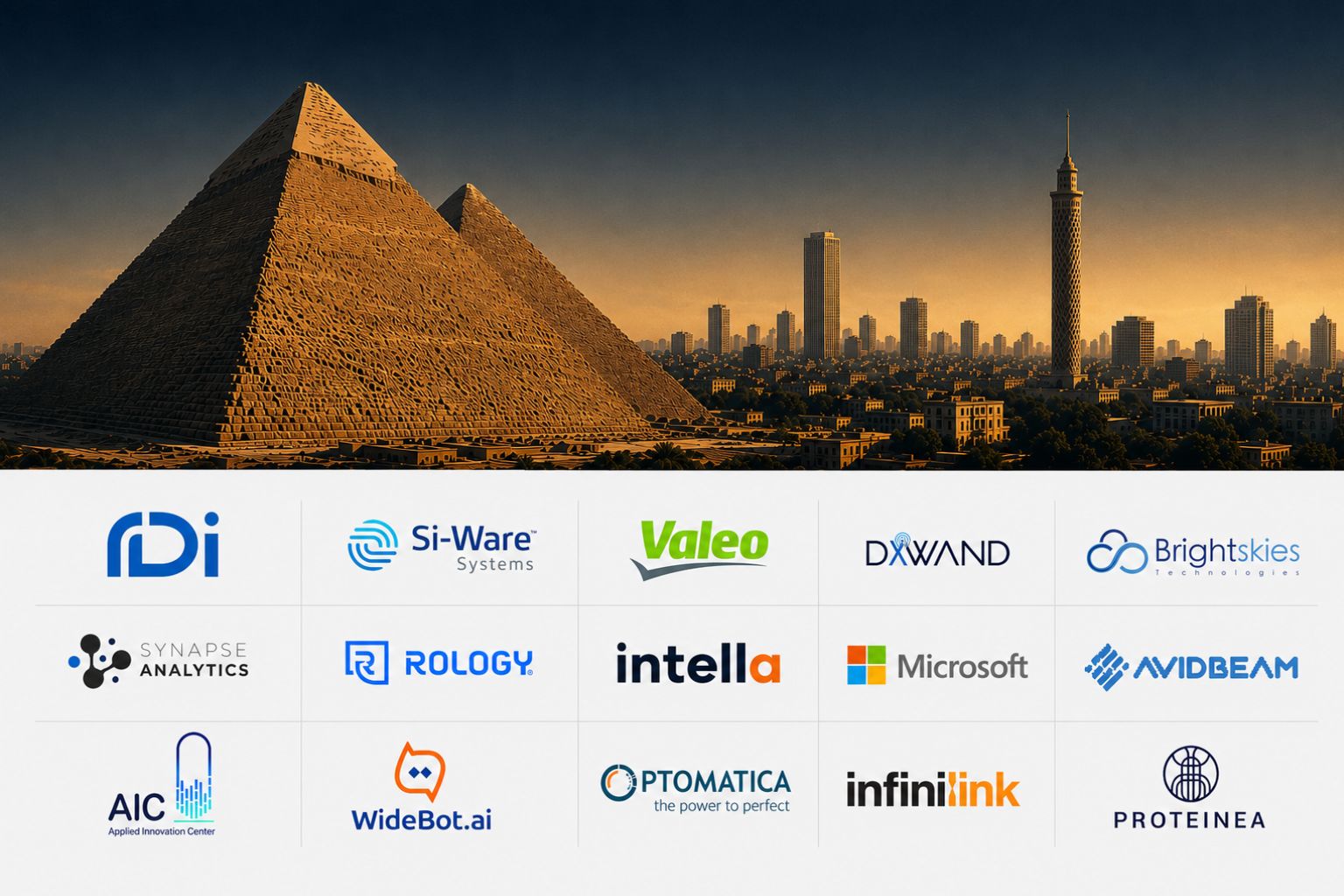

Egypt’s AI Pyramid: The 15 Companies at the Base
The 15 companies building Egypt's AI: the national model, Arabic LLMs, chip startups and fintech tools, and why the best keep moving to the Gulf.
Industry Insights · Egypt Special Report
Karnak and the Cairo engineers: inside Egypt’s AI economy
No sovereign wealth fund is writing $100 billion checks, and no gigawatt campus is rising in the desert. What Egypt has is people: one of the largest engineering pools in the region, a national Arabic model built on a modest budget, and a startup layer whose best names keep moving to the Gulf. Here is a field guide to the companies, labs and talent that make up Egypt’s AI story in 2026.
15Companies and labs profiled
~50kICT graduates a year, per ITIDA
40BParameters in Karnak, the national model
$12.5MLargest disclosed AI raise, 2025
Egypt’s bet on artificial intelligence runs opposite to the one its Gulf neighbors are making. The United Arab Emirates concentrated sovereign capital, compute and models inside a handful of state-aligned holding companies and built an AI empire from the top down. Egypt has none of that firepower. Its national AI strategy targets a single data center it has yet to build, and its largest AI funding round of 2025 was smaller than a rounding error in Abu Dhabi’s OpenAI position.
What Egypt does have is human capital, at a scale few markets can match. Each year it produces roughly 50,000 graduates with information-technology skills, part of a university system that turns out more than 700,000 graduates annually, according to the Information Technology Industry Development Agency (ITIDA). That resource shows up in three places, and this guide is organized around them.
First, the state as builder: a government that has shipped a national Arabic large language model and a set of public AI tools on a fraction of the budget the Gulf commands. Second, the global capability centers: multinational engineering operations in Cairo and Alexandria that employ Egyptian engineers to build AI for the rest of the world. Third, the startup layer: a young base of AI-first companies concentrated in Arabic language and applied verticals, whose strongest names are increasingly basing themselves in Saudi Arabia and the UAE to reach capital and government contracts.
Funding and product details below are verified against primary sources where available. We have profiled 15 companies and institutions, and limited the list to organizations that build Egypt’s AI rather than merely use it: the models and research, the products where AI is the value and the infrastructure beneath them. Egypt’s most credible AI set is smaller than the directory listings suggest, and a clear standard matters more than a round number.
How we chose these companies
Three tests determined inclusion:
- AI is the primary thing the organization builds and ships.
- There is a verifiable output: a model, a product, a documented deployment or a research release cited from a primary source.
- The organization has its founding, its engineering base or both in Egypt.
Funding figures reflect total disclosed funding as of June 2026 and are approximate where a primary source could not confirm the exact figure.
I · The state as builder
Egypt built a national model on a shoestring
Egypt formed its National Council for Artificial Intelligence in 2019 and published a first national strategy in 2021. The second edition, covering 2025 to 2030, raised the ambition considerably: six pillars and 21 initiatives, a target of 30,000 AI specialists and more than 250 AI startups by 2030, and a stated goal of building sovereign AI tools on local data. At the end of 2025 the ministry added an Egyptian Center for Responsible AI to govern deployment inside government. The headline output so far is one model.
01
Applied Innovation Center & Karnak
The Applied Innovation Center is MCIT’s applied-research arm and the team behind Karnak, the national large language model Egypt unveiled in February 2026 at the first AI Everything Middle East and Africa summit in Cairo. Named after the temple complex at Luxor, Karnak is, by its own model card, built on top of Alibaba’s open Qwen3-30B-A3B, a mixture-of-experts architecture, with the model depth-extended to about 40 billion parameters and a tokenizer rebuilt for Arabic. That makes it a localized derivative built on an existing model, a meaningful distinction from the UAE’s Falcon and Jais lines, which were trained from scratch.
Per the ITIDA announcement, Karnak tops the Arabic leaderboard in both the 30 to 40 billion and the 70 to 80 billion size classes. The weights are public on Hugging Face. Egypt has paired the model with applications including SIA, an Arabic and Egyptian-history tutor for high-school students, an AI legal assistant for navigating regulations, and AcQua, a call-monitoring tool for the Digital Egypt service line. Microsoft is in talks to host Karnak on locally hosted cloud infrastructure, the kind of compute Egypt cannot yet supply at scale on its own.
II · Built in Egypt, for the world
The global capability centers
This is the layer that makes Egypt distinct. Where the UAE imports AI talent, Egypt exports its engineers’ labor without the engineers leaving home. Multinationals run large operations in Cairo that build AI for global products, from carmakers to software platforms, with the same engineering base now feeding a young semiconductor-design cluster. The government is targeting $6 billion in technology-service exports by the end of 2026. The logic is familiar: Egyptian engineering salaries run a fraction of European or Gulf levels, the talent is strong, so the work flows in.
02
Valeo Egypt
Valeo’s Cairo operation is the clearest demonstration of what Egypt’s engineering base can do. The French automotive supplier arrived in 2005 with 25 people; the site now employs about 3,000 engineers at Smart Village and is the group’s largest R&D center anywhere, responsible by the company’s own account for roughly 50 percent of Valeo’s worldwide software output. Cairo engineers build the software behind driver-assistance and automated-driving systems, including Park4U automated parking and SCALA lidar, drawing on deep learning, computer vision and data science.
In April 2026, marking 20 years in the country, Valeo opened a dedicated AI development center in Cairo, starting with more than 50 engineers and planning to scale past 100, plugged into a global Valeo network of more than 200 AI specialists. The opening drew the ICT minister and Valeo’s group chief executive, a sign of how central the global-capability-center model has become to Egypt’s economic pitch.
03
Microsoft Egypt Development Center
Microsoft’s Egypt Development Center grew out of the Advanced Technology Lab that Microsoft opened in Cairo in 2007, a unit that began inside Microsoft Research. The lab was built around a specific local strength: the Arabic speech and natural-language expertise Egyptian scientists had accumulated over years of work on a hard language. Its engineers and data scientists now ship parts of global Microsoft products including Bing, advertising, Clarity, SwiftKey and the company’s responsible-AI work.
Microsoft has called Egypt the largest and best-educated computer-science and data-science talent pool in the Middle East and Africa, and said it intends to triple the center’s headcount. The Gulf comparison is sharp: Microsoft keeps its older and larger engineering base in Cairo, close to the talent, while it placed its first formal engineering development center in the Arab world in Abu Dhabi, close to the capital.
04
InfiniLink
InfiniLink is the deep-tech exit that put Egypt’s chip-design talent on the map. Founded in Cairo in 2022 by Ahmed Aboul-Ella and Botros George, the company designs silicon-photonic optical transceiver chiplets and co-packaged optics: components that move data with light instead of copper, the interconnect AI data centers increasingly need as copper reaches its physical limits. In April 2025 it raised a $10 million seed led by Taiwanese chipmaker MediaTek, with Sukna Ventures and Egypt Ventures among the backers.
Seven months later, GlobalFoundries acquired the company to deepen its silicon-photonics roadmap for AI networking. Terms were not disclosed, though Egypt Ventures reported a return of about 400 percent. There is a telling detail here: GlobalFoundries is owned by Abu Dhabi’s Mubadala, so Egyptian AI-infrastructure IP folded into a Gulf-owned manufacturer. It is a pattern that recurs across this list.
05
Si-Ware Systems
Si-Ware Systems is the older half of Egypt’s chip story. Founded in 2004 by Hisham Haddara and Bassam Saadany, the fabless company keeps its core engineering in Cairo and built the world’s first single-chip Fourier-transform infrared spectrometer, sold under the NeoSpectra brand. The sensor shrinks a benchtop lab instrument onto a chip the size of a coin, so users can read the makeup of food, soil, fuel or medicine on the spot.
The AI lives in the analysis layer, where machine-learning models turn raw spectra into material readings through Si-Ware’s cloud software, which is closer to applied data science than to a frontier AI lab. The trajectory echoes the rest of this section: Si-Ware’s NeoSpectra business was acquired by the Swiss laboratory-equipment maker Buchi, one more case of Egyptian deep-tech maturing into a foreign acquisition.
Egypt’s edge in AI is human: one of the region’s largest pools of tech talent, roughly 50,000 IT graduates a year.
III · The Arabic language layer
Where local knowledge beats global scale
Arabic is the fifth most spoken language in the world and among the most underserved by AI, fragmented across more than 25 main dialects that global models handle poorly. Egypt has the largest Arabic-speaking population and a long bench of linguists and engineers, which has made it the region’s center of gravity for Arabic language AI. It is also the niche where Egyptian startups are most defensible. The catch is that the paying customers sit disproportionately in the Gulf, so the companies follow them there.
06
Intella
Intella is the best-funded AI startup on this list and the clearest proof of the Arabic thesis. Founded in 2021, it builds speech-to-text and voice AI tuned to more than 25 Arabic dialects. The company reports transcription accuracy of 95.73 percent, a figure it says beats Google, Microsoft Azure and IBM Watson on Arabic by a wide margin. Its products include the intellaCX contact-center analytics suite and Ziila, a conversational agent it has deployed with Jumia for voice ordering in Egyptian Arabic.
In September 2025 Intella raised a $12.5 million Series A led by Prosus, with 500 Global and Aramco’s Wa’ed Ventures, taking total funding to $16.9 million. It now runs go-to-market teams in both Egypt and Saudi Arabia, and several outlets already describe it as Saudi-based, an early sign of the same drift seen elsewhere.
07
WideBot
WideBot started in Cairo in 2016 as one of the Arab world’s first Arabic chatbot-building platforms and has rebuilt itself around an Arabic-first AI stack. Its conversational tools serve more than 350 clients across a dozen countries, including the Saudi Ministry of Hajj and Umrah and Egypt’s tax portal. In early 2025 it raised a $3 million pre-Series A led by Keheilan Asset Management, backed by Saudi Arabia’s Wafra, to build AQL, its own Arabic large language model hosted on Saudi cloud infrastructure.
WideBot has since moved its headquarters to Riyadh. The relocation tracks where Gulf government contracts and patient capital sit, and it is the cleanest example of an Egyptian AI company following the money across the Red Sea.
08
DXwand
DXwand sells AI that mines an organization’s institutional knowledge and answers questions across channels, from call centers to WhatsApp, in Arabic and English. Founded in 2018 by former Microsoft executive Ahmed Mahmoud, it began as a small-business chatbot and pivoted in 2021 to enterprise and government knowledge mining built on retrieval-augmented generation. It counts more than 200 clients across healthcare, e-commerce, fintech and government.
Its $4 million Series A in January 2024, led by UAE-based Shorooq Partners and Cairo’s Algebra Ventures, brought total disclosed funding to roughly $6.5 million. DXwand keeps a foot in both Cairo and Dubai, the hedged geography many Egyptian AI founders now adopt.
09
RDI
Long before the current wave, RDI was building Arabic language technology. Co-founded in 1993 by Cairo University engineering professor Mohsen Rashwan, the Giza company spent three decades on Arabic speech recognition, text-to-speech, optical character recognition and natural-language processing, including widely used Quran-recitation teaching tools.
RDI is a reminder that Egypt’s Arabic-NLP expertise is not a 2020s phenomenon, and that the talent has always looked outward. The company has run offices in Riyadh and Abu Dhabi for years, a three-decade head start on the Gulf migration its younger peers are making now.
IV · Applied AI across industries
Solving Egyptian problems with Egyptian data
Beyond language, Egyptian AI clusters in the verticals where the country has both a real problem and the data to attack it: financial inclusion in a largely unbanked economy, and healthcare in a system short of specialists. The funding is modest by Gulf standards, and the products are real, increasingly exportable, and built for markets global vendors underserve.
10
Synapse Analytics
Synapse Analytics applies AI to financial decisions: credit scoring, pricing and customer onboarding for banks and fintechs. Founded in 2018, its flagship Konan is a machine-learning operations platform that lets financial institutions build and run credit-risk models without large data-engineering teams, addressing the financial-inclusion gap in an economy where most adults remain underbanked. It has built and deployed scores of models across financial services, logistics and consumer goods.
The company raised a pre-Series A of about $2 million from Egypt Ventures in 2022 and a further $2 million in 2024 led by Silicon Badia and Abu Dhabi’s Hub71, where it is a portfolio company. The Gulf connection again runs through the cap table.
11
Rology
Rology runs an AI-assisted teleradiology platform that connects hospitals to a network of remote radiologists, attacking a severe specialist shortage across Africa and the Middle East. Founded in 2017, its software reads incoming scans and routes each case to the right sub-specialist, cutting reporting time for urgent cases from around 24 hours to under an hour by the company’s account. Its FDA-cleared system has delivered more than 1.3 million reports to over 300 hospitals across 13 countries.
In December 2025 it closed a growth round backed by the Philips Foundation, Johnson & Johnson Impact Ventures, the Sanofi Global Health Unit and MIT Solve, after expanding into Saudi Arabia and Kenya. It is among the clearest cases of an Egyptian startup building infrastructure exportable to other underserved markets.
12
Optomatica
Optomatica is one of the oldest AI shops in the country. Founded in 2003 by Mohammed El-Beltagy, a former Cairo University professor of operations research whose optimization work fed into the design of the Airbus A380, it builds AI, machine-learning and optimization systems across fintech, health, sports technology and conversational AI. Its products include Optofolio, a portfolio-optimization tool, and it has moved into agentic systems and retrieval-augmented generation for enterprise clients.
The research bench is deep: the head of research is Samhaa El-Beltagy, a recognized Arabic natural-language-processing academic, and the firm holds more than a dozen patents. Optomatica runs on a services and products model instead of venture capital, which keeps it lower-profile than the funded startups here, and a reminder that some of Egypt’s strongest applied-AI expertise sits in companies that never raised a round.
V · Deep tech beyond language
Autonomous systems, computer vision and protein AI
Not all of Egypt’s AI production clusters around Arabic. A second tier of deep-tech companies builds computer vision, autonomous-driving software and AI-driven biology platforms, verticals where the engineering depth is unmistakably Egyptian even when the commercial headquarters have drifted toward the Gulf or the West.
13
Brightskies
Brightskies is an Alexandria-based engineering company that built Egypt’s first autonomous driving system. Its BrightDrive platform is a level-4 machine-learning stack covering perception, localization and path planning, developed from scratch by Egyptian engineers and tested on Egyptian roads. In 2020 the company demonstrated BrightDrive as a proof-of-concept vehicle capable of highway driving without human intervention; it has since demonstrated an autonomous bus in Graz, Austria, built with a local partner on the same stack. BrightDrive has joined the Autoware Foundation as an industry member, integrating Autoware’s vision-AI models into its QuantumDrive Zonal Controller.
The company has since spun BrightDrive into a standalone unit headquartered in Dubai while keeping engineering teams in Alexandria, Cairo and Asyut. A second spinoff, Bright EV, manufactures power batteries for light-mobility applications at a factory in Borg El Arab. Brightskies has also partnered with Croatian hypercar maker Rimac on functional-safety systems for the Nevera electric hypercar, a signal that Egyptian automotive-AI work is reaching clients well outside the region. Like the InfiniLink story, the IP is Egyptian; the commercial weight has moved elsewhere.
14
AvidBeam Technologies
AvidBeam was founded in Cairo in 2014 by Dr. Hani Elgebaly, an Intel veteran of more than 18 years who led early videophone and IP-telephony product development in Portland before returning to Egypt to build computer-vision systems. Its VIBE platform uses deep learning and big-data analytics to extract business and security intelligence from video streams at scale, covering smart cities, airports, ports, factories and large public events. The company won the grand prize for Best AI Startup at CES in Las Vegas and was selected by the IFC as one of the winners of its Next 100 African Startups initiative.
Its Gulf footprint is now substantial. AvidBeam has managed more than 18,000 parking spaces in Riyadh through smart video analytics, provided crowd management and security AI at festivals including Soundstorm 2024 and 2025 with more than 450,000 attendees, and deployed face recognition at Egypt’s Misr Stadium. The engineering core remains in Cairo; the revenue increasingly flows from the Gulf. In May 2025 Dr. Elgebaly hosted a smart-city AI summit in Cairo, positioning AvidBeam as a platform for Egypt’s own urban-AI ambitions.
15
Proteinea
Proteinea is the most unusual company on this list: an Egyptian-founded biotech using proprietary AI to design antibody medicines. Founded in Cairo in 2019 by Mahmoud Eljendy and Abdulaziz Elgammal, the company built Ankh, a protein language model developed with the Technical University of Munich and Columbia University and sponsored by Google through its TPU Research Credit Program. When released in January 2023, Ankh was the top-performing protein language model on a set of structure and function benchmarks, outperforming established models at less than 10 percent of the computational cost. The model is named after the ancient Egyptian symbol for life.
The company has since pivoted to focus on Fc antibody engineering for biotherapeutics, designing modular antibody scaffolds with integrated manufacturability, stability and pharmacokinetics considerations. It has raised $10.1 million across multiple rounds from IndieBio, Shorooq Partners, Sawari Ventures and others, and now operates core facilities in Cairo alongside a growing presence in Boston. Proteinea sits at the edge of Egypt’s AI story, a reminder that the country’s research capability extends beyond language and computer vision into life sciences and foundational model building.
To advertise with us, write to nervnow.com/contact
The bigger picture
Three patterns run through the list
Egypt is producing world-class AI work. The open question is how much of the value it manages to keep at home.
01
Talent is the asset, capital is the constraint
Egypt’s edge is people: about 50,000 IT graduates a year and deep benches in Arabic NLP and chip design. What it lacks is the capital and compute the Gulf holds in abundance. The result is a country that produces strong AI work and IP without yet capturing most of the value.
02
Arabic is the defensible niche
The strongest Egyptian AI names cluster around Arabic language: Intella, WideBot, DXwand, RDI and the state’s own Karnak. It is the one area where local knowledge outperforms global scale, and where Egypt’s linguistics and engineering base is hardest to copy.
03
The Gulf is the gravity well
Intella and WideBot are basing themselves in Riyadh, Synapse sits in Hub71, and InfiniLink was bought by a Mubadala-owned foundry. Egyptian AI is increasingly built by Egyptians, then funded and headquartered next door.
A timeline · key milestones
Three decades, one constraint
1993
RDI is founded in Giza, beginning three decades of Arabic speech and language work, with Gulf offices from early on.
2004
Si-Ware Systems is founded in Cairo, later building the world’s first single-chip infrared spectrometer.
2005
Valeo opens in Egypt with 25 engineers. The Cairo site will grow into the group’s largest R&D center worldwide.
2007
Microsoft opens its Advanced Technology Lab in Cairo, the seed of its Egypt Development Center.
2012
Brightskies is founded in Alexandria, building the engineering base that will later produce Egypt’s first autonomous driving system.
2014
AvidBeam is founded in Cairo by a team of former Intel engineers, beginning a decade of AI-powered video analytics.
2017–18
Rology and Synapse Analytics are founded, and MCIT stands up the Applied Innovation Center. The modern applied-AI base takes shape.
2019
Egypt forms the National Council for Artificial Intelligence. Proteinea is founded in Cairo, beginning work on AI-driven protein engineering.
2021
The first National AI Strategy is published. Intella is founded in Cairo to tackle dialectal Arabic speech.
Jan 2023
Proteinea releases Ankh, a protein language model developed with TU Munich and Columbia University and sponsored by Google, ranking as the world’s top-performing protein language model on release.
Jan 2025
The second National AI Strategy, covering 2025 to 2030, launches, targeting 30,000 AI specialists and more than 250 AI startups, plus a national foundation model.
Nov 2025
GlobalFoundries acquires Cairo’s InfiniLink, an exit built on AI data-center photonics, returning a reported 400 percent to Egypt Ventures.
Feb 2026
Egypt unveils Karnak, its national Arabic model, at the first AI Everything Middle East and Africa summit in Cairo.
Apr 2026
Valeo opens a dedicated AI development center in Cairo, marking 20 years in Egypt and a deeper move into AI engineering.
Egyptian AI is increasingly built by Egyptians, then funded and headquartered next door.
Editorial note on sources
Funding figures are drawn from public sources including company announcements, Magnitt, Wamda, MENAbytes, Disrupt Africa, TechCrunch and primary press coverage, and reflect total disclosed funding as of June 2026 where available. Several performance metrics, including transcription-accuracy and clinical-accuracy claims, are reported by the companies themselves and are attributed as such in the text. Figures may vary across sources or have changed since the time of research. In case of a discrepancy, write to us at editorial@nervnow.com and we will make the necessary corrections. Researched and written by NervNow Editorial.
N
NervNow Editorial
Intelligence for the C-suite, from the age of intelligence.
Stay updated with NervNow Weekly
The AI stories that matter to operators and investors, once a week.
Subscribe nowResearched and written by NervNow Editorial. To advertise or flag a correction, write to nervnow.com/contact.